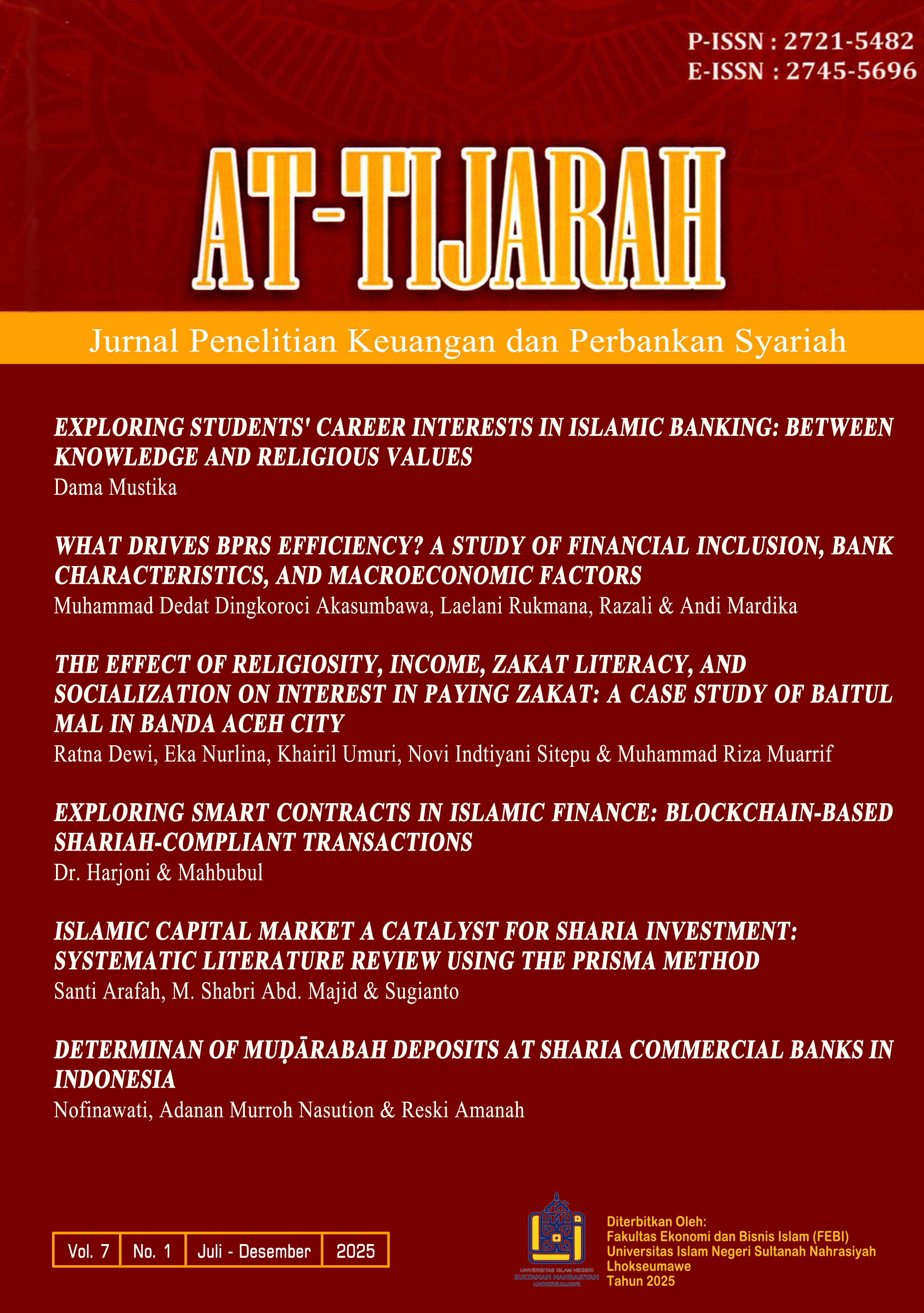
The Exploring Students' Career Interests In Islamic Banking: Between Knowledge And Religious Values
DOI:
https://doi.org/10.52490/at-tijarah.v7i1.6287Keywords:
knowledge of islamic banking, level of religiosity, career interestsAbstract
With the increasing awareness of Sharia-based financial services and the growth of the Sharia banking industry, it is important to understand the determinants of career decisions of the younger generation. This study aims to analyze the factors that influence students' career interest in Sharia banking through Sharia banking knowledge and religiosity. This study uses quantitative data with a questionnaire conducted through Google Forms, distributed to students who have completed the Sharia banking course. The population was 110 respondents at STAI Hubbulwathan, and 63 respondents were research samples who filled out the questionnaire online. The results of the study showed that career interest in Sharia banking was greatly influenced by knowledge of Sharia banking with a p-value of 0.006 and the level of religiosity had a significant effect with a p-value of 0.002 on career interest in Sharia banking. The importance of higher education institutions integrating Islamic banking material more deeply into the curriculum, the need for socialization regarding career prospects in Islamic banking, and Islamic principles in economics are important so that students better understand the opportunities in this sector. Providing training programs, seminars, and short courses can also be an alternative to improve students' practical knowledge.
References
Almaqtari, F. A., Al-Hattami, H. M., & Yahya, A. T. (2021). The relationship between religiosity and career choices in Islamic financial institutions: Evidence from Yemen. International Journal of Islamic and Middle Eastern Finance and Management, 14(1), 145-164. https://doi.org/10.1108/IMEFM-06-2020-0286
Amri, A., & Yani, F. (2019). Pengaruh Pengetahuan Perbankan Syariah Terhadap Minat Berkarir di Perbankan Syariah. Jurnal Ekonomi Syariah, 7(2), 45-59. https://doi.org/10.1234/jes.v7i2.543
Bakar, M. I., Abdullah, R., & Hassan, S. (2021). Interacting Determinants of Career Interest in Islamic Banking: The Role of Knowledge, Religiosity, and Financial Reward. Journal of Islamic Finance and Economics, 12(2), 45-60. doi:10.1108/JIFE-2021-0010.
Fauziah, R. (2020). Tingkat Religiusitas dan Preferensi Karier Mahasiswa di Sektor Ekonomi Syariah. Jurnal Ilmu Ekonomi Islam, 8(3), 90-102. https://doi.org/10.1234/jiei.v8i3.678
Hussain, M., Shiraz, A., & Usman, T. (2022). Career Prospects in Islamic Banking: A Comparative Analysis with Conventional Banking. Journal of Islamic Finance, 10(3), 55-72. doi:10.1108/JIF-2022-0025.
Iqbal, Z., Mirakhor, A., & Zaidi, S. (2020). Knowledge and awareness of Islamic banking principles among university students: A case study. Journal of Islamic Accounting and Business Research, 11(2), 123-145. https://doi.org/10.1108/JIABR-03-2019-0045
Kassim, S. H., Mohamed, N., & Zainol, Z. (2020). The Role of Financial Literacy in Promoting Career Interest in Islamic Banking: Evidence from Malaysia. International Journal of Islamic and Middle Eastern Finance and Management, 13(2), 123-140. doi:10.1108/IMEFM-2020-0038.
Mustika, et al. (2024). Determinan Minat Berkarir Mahasiswa di Perbankan Syariah. Jurnal Akuntansi dan Ekonomika, 14(2), 163-173.Sutrisno, E., & Rahmawati, D. (2021). Pertimbangan Pasar Kerja dan Minat Mahasiswa Berkarir di Sektor Perbankan Syariah. Jurnal Ekonomi dan Bisnis Islam, 6(4), 112-126. https://doi.org/10.1234/jebi.v6i4.234
Sarea, A. M., & Hanefah, H. M. (2021). Islamic Finance Literacy and Its Impact on Career Choice Among Graduates. International Journal of Islamic and Middle Eastern Finance and Management, 14(1), 22-35. doi:10.1108/IMEFM-2021-0038.
Sugiyono. (2021). Metode Penelitian Kuantitatif Kualitatif dan R&D. Bandung: Alfabeta
Undang-Undang No. 21 Tahun 2008, Tentang Perbankan Syariah, Pasal 1 butir 23.
Purwanto, a. et al. (2021) education research quantitative analysis for little respondents. Jurnal Studi Guru dan Pembelajaran, 4(2) 335-350. https://doi.org/10.30605/jsgp.4.2.2021.13
Sarstedt, M., Ringle, C. M., & Hair, J. F. (2017). Partial Least Squares Structural Equation Modeling. In Handbook of Market Research. Springer International Publishing.
Yusoff, W. S. W., & Sabri, H. (2022). The Influence of Religiosity on Career Choice in Islamic Banking: Evidence from Malaysia. Journal of Islamic Accounting and Business Research, 13(4), 123-138. doi:10.1108/JIABR-2022-0015.
Downloads
Published
How to Cite
Issue
Section
License
Copyright (c) 2025 DamaMustika Dama

This work is licensed under a Creative Commons Attribution-ShareAlike 4.0 International License.