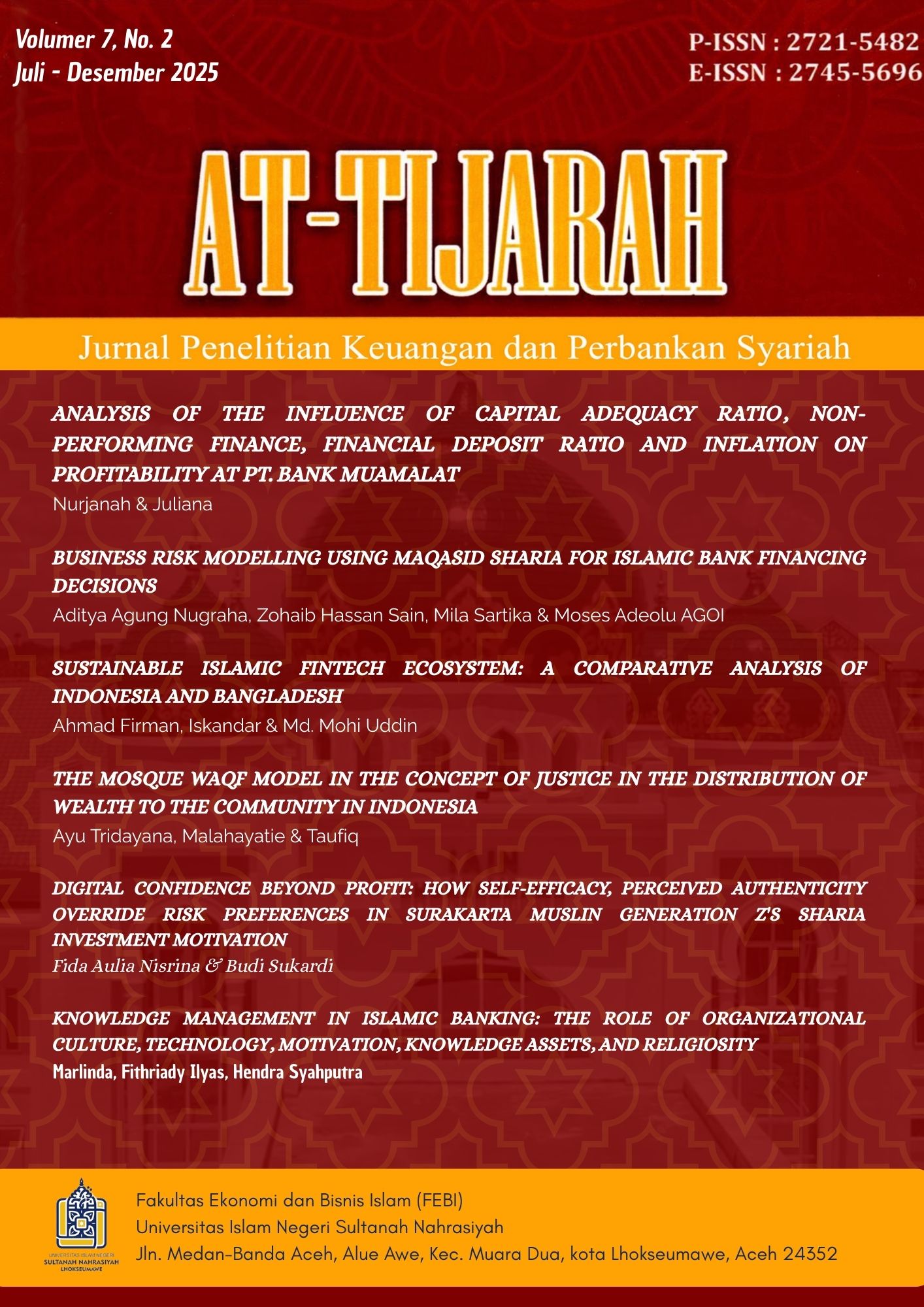
Analysis of the Influence of Capital Adequacy Ratio, Non-Performing Finance, Financial Deposit Ratio and Inflation on Profitability at PT. Bank Muamalat
DOI:
https://doi.org/10.52490/at-tijarah.v7i2.6709Keywords:
Profitability, CAR, NPF, FDR, InflationAbstract
This study aims to analyze the influence of variables on Bank Muamalat's profitability during 2016-2023 using a quantitative approach. The variables tested included CAR (Capital Adequacy Ratio), NPF (Non-Performing Financing), FDR (Financing-to-Deposit Ratio), and inflation. The results of the study show that the variable that has the most significant influence on profitability is NPF (Non-Performing Financing), which has a significant effect on the bank's profitability. This shows that effective non-performing loan management can directly improve the bank's financial performance. Meanwhile, inflation significantly affects profitability, as rising inflation can reduce consumers' purchasing power and affect banks' performance. On the other hand, the CAR (Capital Adequacy Ratio) does not have a significant effect on profitability, indicating that while maintaining financial stability is important, its impact on profitability is not substantial. The same applies to the FDR (Financing-to-Deposit Ratio), which has no significant effect on profitability. These findings imply that NPF management and inflation monitoring should be the primary focus in efforts to increase the profitability of Islamic banks.
References
Arnum Puji Astuti,Malahayatie,Rahmawati. Analisis Swot Dan Bcg Pada Pemasaran Syariah Pada Usaha Kopi Di Kota Takengon, Jurnal Adz Dzahab, Vol 9 no 2 tahun 2024. https://doi.org/10.47435/adz-dzahab.v9i2.3316
Azizah, S. N. (2024). Analisis Pengaruh CAR, FDR, dan NPF Terhadap Profitabilitas Pada Bank Umum Syariah Di Indonesia. Αγαη, 15(1), 37–48.
Burhanuddin. (2015). Aspek Hukum Lembaga Keuangan Syariah. Graha Ilmu.
Haris, M., Tan, Y., Malik, A., & Ain, Q. U. (2020). A Study on the Impact of Capitalization on the Profitability of Banks in Emerging Markets: A Case of Pakistan. Journal of Risk and Financial Management, 13(9), 217. https://doi.org/10.3390/jrfm13090217
Harjoni, H., & Nola, S. L. (2025). Pengaruh Literasi Keuangan, Life Style, dan Locus Of Control Terhadap Perilaku Pengelolaan Keuangan Mahasiswa Ekonomi Syariah Febi Angkatan 2019. Jurnal BAABU AL-ILMI: Ekonomi dan Perbankan Syariah, 9(2), 173-179. https://doi.org/10.29300/ba.v9i2.5011
Kasmir. (2011). Analisis Laporan Keuangan. Rajawali Pers.
Kuncoro, M. S. (2011). Manajemen Perbankan Teori dan Aplikasi. Erlangga.
Mahendra, W., & Sahibuddin, S. A. (2022). Determinan Nilai Perusahaan pada Sektor Perusahaan Properti dan Real Estate di Indeks Saham Syariah Indonesia. Nominal: Barometer Riset Akuntansi Dan Manajemen, 11(2), 220–232. https://doi.org/10.21831/NOMINAL.V11I2.49191
Mubarok, H., Suryadi, M., & Harahap, R. D. (2024). Pengaruh Pembiayaan Natural Uncertainty Contract (NUC), Natural Certainty Contract (NCC), dan Non Performing Financing (NPF) Terhadap Profitabilitas Bank Umum Syariah di Indonesia (Periode 2016-2018). Wawasan : Jurnal Ilmu Manajemen, Ekonomi Dan Kewirausahaan, 2(1), 71–89.
Muhammad Firdaus. (2017). Konsep dan Implementasi Bank Syariah. Renaisan.
Muhammad Rahmat, Yaumul Khair Afif, & Ahmad Daud. (2024). Pengaruh Inflasi Dan Non Performing Financing Terhadap Profitabilitas Bank Umum Syariah Di Indonesia Periode 2018-2022. Jurnal Ekonomi Dan Keuangan Syariah, 3(2), 982–999. https://jurnal.perima.or.id/index.php/JEKSya
Putong, I. (2000). Pengantar Ekonomi Mikro dan Makro. Ghalia Indonesia.
Razali, R., & Rahmawati, R. (2024). Hilirisation Agricultural Zakat as a Basis for Increasing Community Income. Management of Zakat and Waqf Journal (MAZAWA), 6(1), 1–18. https://doi.org/10.15642/mzw.2024.6.1.1-18
Regina, F. (2024). Pengaruh FDR dan BOPO Terhadap Profitabilitas Bank Umum Syariah di Indonesia Periode 2020-2023. Jurnal Ilmiah Ekonomi Dan Manajemen, 2(6), 754–762. http://perpustakaan.iainpekalongan.ac.id
Sobana, D. H. (2017). Manajemen Keuangan Syariah. In CV. Pustaka Setia. CV. Pustaka Setia.
Syaipudin, L., & Luthfi, A. (2024). Pengaruh Financing to Debt Ratio dan Net Profit Margin terhadap Profitabilitas Bank Muamalat Indonesia Periode 2013-2022. 1(1), 10–21.
Ulfatuzahroh. (2020). Analisis Pengaruh CAR, NPF, FDR Dan BOPO Terhadap Profitabilitas (Return On Asset) Pada PT Bank Muamalat Indonesia periode 2012-2020. IAIN Purwokerto.
Utami, M., & Sihotang, M. K. (2024). Pengaruh Inflasi Dan Jumlah Uang Beredar Terhadap Profitabilitas Perbankan Syariah Di Indonesia. Αγαη, 15(1), 37–48.
Venia, I., Yoesoef, Y., & Rahmawati (2024). Pengaruh Promosi, Gaya Hidup Dan Pekerja Terhadap Minat Masyarakat Menggunakan BSI LINK Di Kecamatan Muara Dua Kota Lhokseumawe. Borneo Islamic Finance and Economics Journal, 4(2), 99-113. https://doi.org/10.21093/bifej.v4i2.9441
Widyastuti, P. F., & Aini, N. (2021). Pengaruh CAR, NPL, LDR Terhadap Profitabilitas Bank (ROA) Tahun 2017-2019. Jurnal Ilmiah Mahasiswa Akuntansi) Universitas Pendidikan Ganesha, 12(03), 2614–1930.
Wijaya, L. D. (2019). Manajemen Perbankan. Ghalia Medika.
Downloads
Published
How to Cite
Issue
Section
License
Copyright (c) 2025 Nurjanah Nurjanah, Juliana

This work is licensed under a Creative Commons Attribution-ShareAlike 4.0 International License.