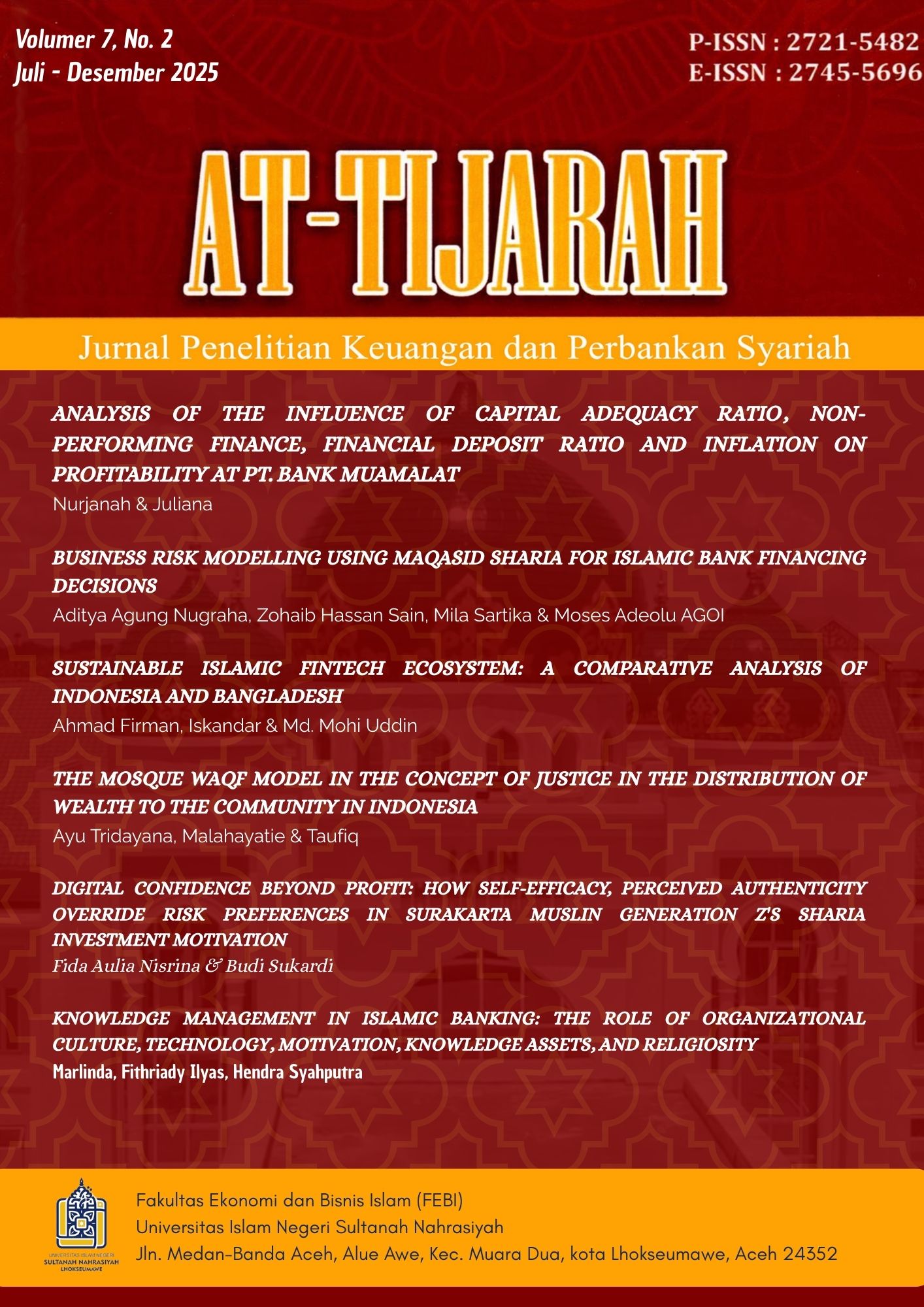
Sustainable Islamic Fintech Ecosystem: A Comparative Analysis Of Indonesia And Bangladesh
DOI:
https://doi.org/10.52490/at-tijarah.v7i2.6769Keywords:
Sharia FinTech, Islamic Finance, Digital Economy, Financial Inclusion, Regulatory Framework, Comparative Analysis. .Abstract
This article presents a comprehensive analysis of the integration of Financial Technology (FinTech) into the Islamic financial ecosystem in Indonesia, focusing on the paradox between its massive market potential and its still-low inclusive realization. The convergence of the world's largest Muslim population, a rapidly growing digital economy, and a developing sharia finance industry places Indonesia in a strategic position. However, behind the positive macro indicators, structural challenges are hindering widespread adoption, primarily due to low levels of Sharia financial literacy and inclusion. The key research gap identified is the lack of a systemic analysis linking the fragmentation of the regulatory framework, specifically the dualism between the Financial Services Authority (OJK) and the fatwas of the National Sharia Council-Indonesian Ulema Council (DSN-MUI), with the public trust deficit that hampers inclusion. Using qualitative methods through a comparative case study approach with Malaysia as a benchmark, this research finds that legal uncertainty arising from an incohesively integrated regulatory framework is the root cause of the low trust and effectiveness of literacy programs. These findings lead to strategic policy recommendations centered on regulatory harmonization to create legal certainty, a fundamental prerequisite for building a sustainable and inclusive Sharia FinTech ecosystem.
References
Alam, N. (2021). Malaysia’s Regulatory Framework: A Catalyst for FinTech Adoption. ISEAS Yusof Ishak Institute, 128(2021), 1–9.
Al-Arafah Islami Bank Limited. (2024, January 8). AIBL launches Islamic wallet: Country's first Shariah-based digital financial service. https://www.aibl.com.bd/news/aibl-launches-islamic-wallet-countrys-first-shariah-based-digital-financial-service/
Apriani, A. (2022). Pengaruh Literasi Keuangan Syariah Dan Technology Keuangan Terhadap Inklusi Keuangan Syariah Pada Mahasiswa Perbankan Syariah Uin Raden Fatah Palembang. Universitas Islam Negeri Raden Fatah Palembang.
Arner, D. W., Barberis, J., & Buckley, R. P. (2020). The evolution of Fintech: A new post-crisis paradigm? Georgetown Journal of International Law, 47, 1271.
Arnum Puji Astuti,Malahayatie,Rahmawati. Analisis Swot Dan Bcg Pada Pemasaran Syariah Pada Usaha Kopi Di Kota Takengon, Jurnal Adz Dzahab Vol 9 no 2 tahun 2024. https://doi.org/10.47435/adz-dzahab.v9i2.3316
Arseto, D. D., & Soemitra, A. (2022). Analysis of the Influence of Attitudes and Perceptions on Decisions to Use Sharia Fintech Peer to Peer Lending in Indonesia With Satisfaction as an Intervening Variable. In Reslaj Religion Education Social Laa Roiba Journal. https://doi.org/10.47467/reslaj.v4i4.1048
Asif, M., Gang, C., & Asif, S. (2023). The role of fintech in promoting financial inclusion: A comprehensive literature review. Journal of Risk and Financial Management, 16(4), 233. DinarStandard & Elipses. (2025). Global Islamic Fintech Report 2024/25.
Atichasari, A. S., Kristanti, K., Hayriah, N., & Wulandari, S. S. (2023). Analysis of Quality and Implementation of Sharia Financial Services Based on Financial Technology in Indonesia. In International Journal of Current Science Research and Review. https://doi.org/10.47191/ijcsrr/v6-i7-110
Bangladesh Bank. (2025, April-June). Quarterly Report on Islamic Banking In Bangladesh. https://www.bb.org.bd//pub/quaterly/islamic_banking/ibq2_june_2025_final.pdf
Bangladesh Sangbad Sangstha (BSS). (2024, April 9). Nagad launches Shariah-based Islamic account for merchants. https://www.bssnews.net/business/170623
Feghali, K., Daher, L., & Nassif, P. (2024). The Influence of Fintech on Financial Inclusion: An International Study. Indonesian Management and Accounting Research, 23(1), 65–86. https://doi.org/10.25105/imar.v23i1.18312
Fitri, M., Samri, Y., & Nasution, J. (2023). Pendayagunaan Zakat Produktif… Pendayagunaan Zakat Produktif Dalam Tujuan Pembangunan Berkelanjutan (Sdgs) Di Indonesia. Hassan, M. K., Rabbani, M. R., & Ali, M. A. M. (2020). Challenges for Islamic finance and banking in post-COVID era and the role of novel financial technologies. Journal of Economic Cooperation and Development, 41(3), 93-116.
Gazali, H. A., Fahmi, A. S., & Auliya, S. (2025). Penerapan Prinsip Keuangan Berbasis Al-Qur’an Dalam Optimalisasi Fintech Syariah Di Indonesia. In Jes (Jurnal Ekonomi Syariah). https://doi.org/10.30736/jes.v10i1.1073
Habib, M. (2019, January 3). Crowdfunding laws and the legal vacuum in Bangladesh. The Daily Star. https://www.thedailystar.net/law-our-rights/news/crowdfunding-laws-and-the-legal-vacuum-bangladesh-168264
Harjoni, H., & Nola, S. L. (2025). Pengaruh Literasi Keuangan, Life Style, dan Locus Of Control Terhadap Perilaku Pengelolaan Keuangan Mahasiswa Ekonomi Syariah Febi Angkatan 2019. Jurnal BAABU AL-ILMI: Ekonomi dan Perbankan Syariah, 9(2), 173-179. https://doi.org/10.29300/ba.v9i2.5011
Hossain, T., Rahman, A., & Jahan, S. (2024). Fintech trends and Islamic finance in South Asia. South Asia Financial Studies Institute.
Irma Muzdalifa, Inayah Aulia Rahma, B. G. N. (2018). ( Pendekatan Keuangan Syariah). Jurnal Masharif Al- Syariah:Jurnal Ekonomi Dan Perbankan Syariah, 3(1), h. 1-24.
Judijanto, L., & Mu’min, H. (2024). The Effect of Islamic Financing on the Growth of Micro, Small and Medium Enterprises in Indonesia. West Science Islamic Studies, 2(04), 191–197. https://doi.org/10.58812/wsiss.v2i04.1349
KNEKS. (2025). Indonesia Sharia Economy Masterplan 2019-2024. Komite Nasional Ekonomi dan Keuangan Syariah.
Naz, F., Karim, S., Houcine, A., & Naeem, M. A. (2022). Fintech Growth During COVID-19 in MENA Region: Current Challenges and Future Prospects. In Electronic Commerce Research. https://doi.org/10.1007/s10660-022-09583-3
Norrahman, R. A. (2023). Peran Fintech Dalam Transformasi Sektor Keuangan Syariah. https://doi.org/10.62421/jibema.v1i2.11
putra, D. (2024). Implementasi Sharia Complaince Dalam Platform Crowdfunding Syariah Bagi UMKM Studi Kasus: PT Shafiq Digital Indonesia. In Al-Mutsla. https://doi.org/10.46870/jstain.v6i1.939
Razali, R., & Rahmawati, R. (2024). Hilirisation Agricultural Zakat as a Basis for Increasing Community Income. Management of Zakat and Waqf Journal (MAZAWA), 6(1), 1–18. https://doi.org/10.15642/mzw.2024.6.1.1-18
Siska, E. (2022). Financial Technology (FinTech) and Its Impact on Financial Performance of Islamic Banking. In Arbitrase Journal of Economics and Accounting. https://doi.org/10.47065/arbitrase.v2i3.338
Stability, F. (2024). Financial Stability Review.
Susilawati, C., Sulaiman, A. A., Abduh, M., Prasetyo, Y., & Athoillah, M. A. (2021). Comparative Study on the Regulation of Sharia Financial Technology in Indonesia and Malaysia. Jurisdictie: Jurnal Hukum Dan Syariah, 12(1), 1–19. https://doi.org/10.18860/j.v12i1.12213
Tahabil Limited. n.d., https://share.google/Wzt06344mPtJtdWGd
The Business Standard. (2024, February 7). Prime Bank launches Hasanah Islamic banking services on MyPrime. https://www.tbsnews.net/economy/corporates/prime-bank-launches-hasanah-islamic-banking-services-myprime-816346
Venia, I., Yoesoef, Y., & Rahmawati (2024). Pengaruh Promosi, Gaya Hidup Dan Pekerja Terhadap Minat Masyarakat Menggunakan BSI LINK Di Kecamatan Muara Dua Kota Lhokseumawe. Borneo Islamic Finance and Economics Journal, 4(2), 99-113. https://doi.org/10.21093/bifej.v4i2.9441
Yan, J. (2024). How the Use of Alternative Information in Risk Management Fintech Platforms Influences SME Lending: A Qualitative Case Study. In Qualitative Research in Financial Markets. https://doi.org/10.1108/qrfm-08-2023-0198
Downloads
Published
How to Cite
Issue
Section
License
Copyright (c) 2025 ahmad firman, Iskandar, Md. Mohi Uddin

This work is licensed under a Creative Commons Attribution-ShareAlike 4.0 International License.