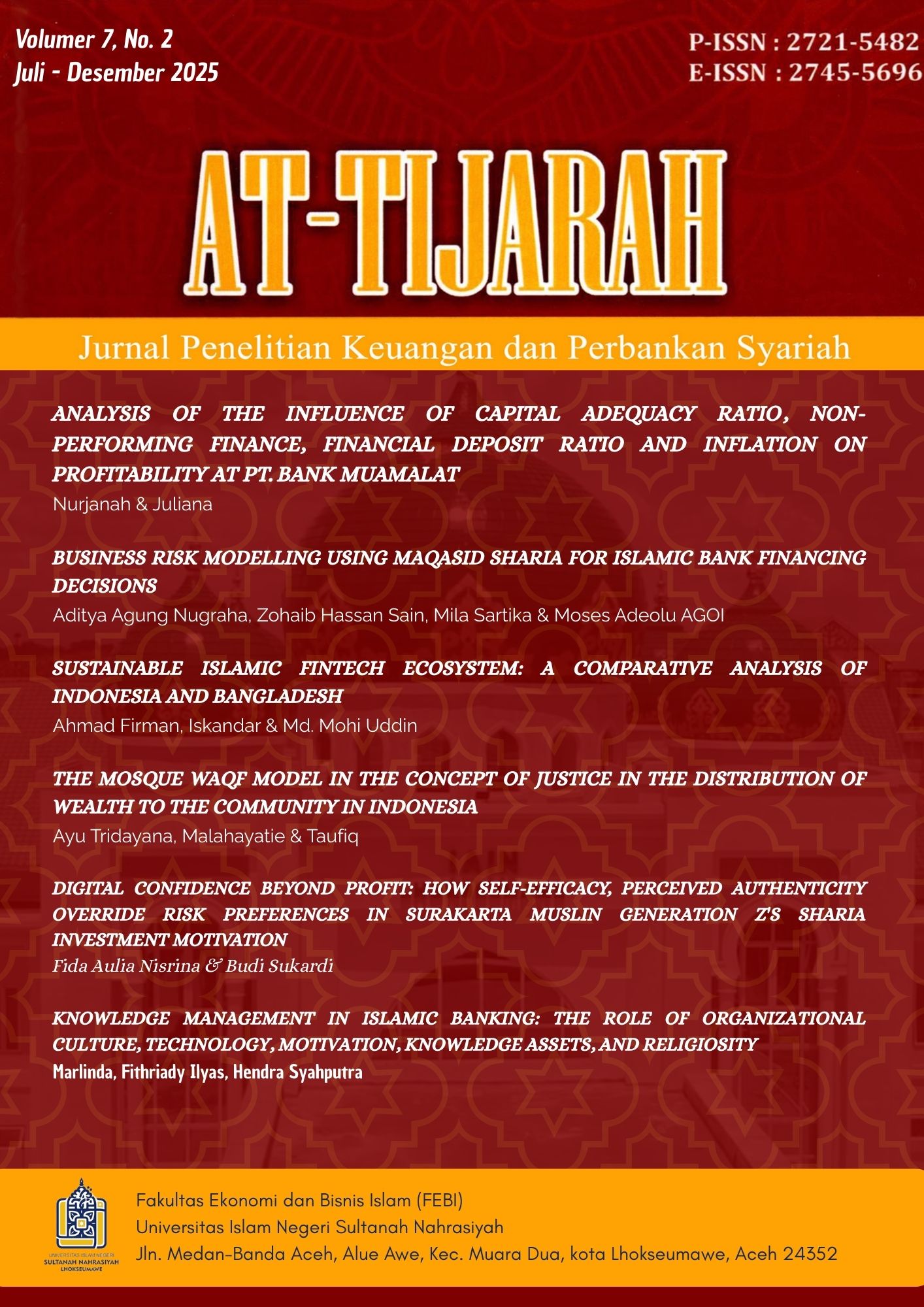
Business Risk Modelling Using Maqasid Sharia For Islamic Bank Financing Decisions
DOI:
https://doi.org/10.52490/at-tijarah.v7i2.6775Keywords:
Maqasid Sharia, business risk, decision-making, Sharia financing, Bank Syariah IndonesiaAbstract
This research aims to model business risk based on Maqasid Sharia as a framework for financing decision-making at Bank Syariah Indonesia (BSI) Pekalongan Branch. This study departs from the increasing complexity of financing risks amid demands for compliance with Sharia principles and financial stability. This study seeks to answer the question of the extent to which Maqasid Sharia values, such as hifz al-mal (property protection), hifz al-nafs (protection of life and welfare), and hifz al-din (protection of religious values), can be integrated into the risk management and decision-making process of Islamic bank financing. This study employs a qualitative-descriptive approach, collecting data through in-depth interviews, field observations, and an analysis of financing documents at the BSI Pekalongan Branch. The data was analysed thematically by linking empirical practices and Maqasid Sharia theory in the study of business risk management. The study results show that the application of Maqasid Sharia values has been gradually internalised in feasibility analysis, contract determination, and financing monitoring. The principle of hifz al-mal is the basis for prudent protection of banks' and customers' assets. Hifz al-nafs directs policies towards businesses oriented towards social benefits, and hifz al-din ensures compliance with Sharia fatwa and Islamic business ethics. The integration of these values has been proven to reduce non-performing financing (NPF) and strengthen customer confidence. The implications of this study confirm that maqasid Sharia plays a role as a meta-framework in risk management, which can simultaneously balance financial and moral goals. These findings offer a theoretical contribution to expanding the Sharia risk management paradigm and opening space for developing value-based risk models to support sustainable financing practices in the Islamic banking sector.
References
Abdel Megeid, N. S. (2017). Liquidity risk management: conventional versus Islamic banking system in Egypt. Journal of Islamic Accounting and Business Research, 8(1). https://doi.org/10.1108/JIABR-05-2014-0018
Abdullah, A., & Muhammad, J. (2013). Ethical values in Islamic financial planning. Jurnal Pengurusan, 38. https://doi.org/10.17576/pengurusan-2013-38-13
Abdullah, H., Md Zain, F. A., Tajuddin, S. A. F. S. A., Mohammed Foziah, N. H., & Ishak, M. S. I. (2025). Developing employee motivation index: McClelland and Maqasid Shariah. Journal of Islamic Accounting and Business Research, 16(1). https://doi.org/10.1108/JIABR-07-2023-0235
Adinugraha, H. H., Fikri, M. K., & Rohmah, S. (2024). Prinsip Etika Islami dalam Aktivitas Ekonomi dan Bisnis (A. Sadali & U. Najwa (eds.)). Eureka Media Aksara.
Adinugraha, H. H., Shulthoni, M., & Al-kasyaf, M. Z. (2025). Model of halal management practices in Islamic banking: empirical evidence from Bank Syariah Indonesia. QTISHADUNA: Jurnal Ilmiah Ekonomi Kita, 14(1), 25–46. https://doi.org/https://doi.org/10.46367/iqtishaduna.v14i1.2333
Al Hammadi, M., Jimber-Del Río, J. A., Ochoa-Rico, M. S., Montero, O. A., & Vergara-Romero, A. (2024). Risk Management in Islamic Banking: The Impact of Financial Technologies through Empirical Insights from the UAE. Risks, 12(2). https://doi.org/10.3390/risks12020017
Alziyadat, N., & Ahmed, H. (2019). Ethical decision-making in Islamic financial institutions in light of Maqasid Al-Sharia: A conceptual framework. Thunderbird International Business Review, 61(5). https://doi.org/10.1002/tie.22025
Arnum Puji Astuti,Malahayatie,Rahmawati. Analisis Swot Dan Bcg Pada Pemasaran Syariah Pada Usaha Kopi Di Kota Takengon, Jurnal Adz Dzahab, Vol 9 no 2 tahun 2024.
Arsyi, M. (2024). Maqasid Shariah Implementation on Sukuk Analysis. Journal of Islamic Economics Literatures, 4(2). https://doi.org/10.58968/jiel.v4i2.338
Boubaker, S., Uddin, M. H., Kabir, S. H., & Mollah, S. (2023). Does cost-inefficiency in Islamic banking matter for earnings uncertainty? Review of Accounting and Finance, 22(1). https://doi.org/10.1108/RAF-07-2022-0193
BSI. (2025). Laporan Keuangan. https://ir.bankbsi.co.id/financial_reports.html
Cahyandari, R., Kalfin, R., Sukono, R., Purwani, S., Ratnasari, D., Herawati, T., & Mahdi, S. (2023). The Development of Sharia Insurance and Its Future Sustainability in Risk Management: A Systematic Literature Review. In Sustainability (Switzerland) (Vol. 15, Issue 10). https://doi.org/10.3390/su15108130
Campra, M., Brescia, V., Jafari-Sadeghi, V., & Calandra, D. (2021). Islamic countries and Maqasid al-Shariah towards the circular economy: The Dubai case study. European Journal of Islamic Finance, 17(April 2021). https://doi.org/10.13135/2421-2172/4560
Durst, S., & Zieba, M. (2020). Knowledge risks inherent in business sustainability. Journal of Cleaner Production, 251. https://doi.org/10.1016/j.jclepro.2019.119670
Elgharbawy, A. (2020). Risk and risk management practices: A comparative study between Islamic and conventional banks in Qatar. Journal of Islamic Accounting and Business Research, 11(8). https://doi.org/10.1108/JIABR-06-2018-0080
Faliza, N. (2023). Can Organizational Culture Encourage Islamic Banking Performance?: The Role of Organizational Commitment as Mediation. International Journal of Professional Business Review, 8(6). https://doi.org/10.26668/businessreview/2023.v8i6.2307
Goud, B., Uddin, T. A., & Fianto, B. A. (2021). Islamic fintech and ESG goals: Key considerations for fulfilling maqasid principles. In Islamic Fintech. https://doi.org/10.4324/9781003014614-2
Güney, N. (2024). Maqāsid al-Sharī‘a in Islamic Finance: A Critical Analysis of Modern Discourses. Religions, 15(1). https://doi.org/10.3390/rel15010114
Harjoni, H., & Nola, S. L. (2025). Pengaruh Literasi Keuangan, Life Style, dan Locus Of Control Terhadap Perilaku Pengelolaan Keuangan Mahasiswa Ekonomi Syariah Febi Angkatan 2019. Jurnal BAABU AL-ILMI: Ekonomi dan Perbankan Syariah, 9(2), 173-179. https://doi.org/10.29300/ba.v9i2.5011
Henderianto, R., Adinugraha, H. H., Shultoni, M., & Andrean, R. (2025). Innovation in Technology, Financial Literacy, and Security Risk in Cardless Withdrawals: Case Study on Customers Adoption at Bank Syariah Indonesia. Al-Intaj : Jurnal Ekonomi Dan Perbankan Syariah, 11(1), 51. https://doi.org/10.29300/aij.v11i1.5925
Hendri, L. (2021). Examining Maqasid Sharia Attainment: Case of Financing Products of Bank Muamalat Indonesia. Journal of Islamic Economic and Business Research, 1(2). https://doi.org/10.18196/jiebr.v1i2.13
Hija, L. N. (2024). Bibliometric Mapping on Maqasid Shariah in Waqf Implementation. Journal of Islamic Economics Literatures, 4(2). https://doi.org/10.58968/jiel.v4i2.337
https://doi.org/10.47435/adz-dzahab.v9i2.3316
Imaduddin, M., & Sharofiddin, A. (2021). Identifying Creditworthiness Criterions and Financing Approval Process of Islamic Banks in Indonesia. Lecture Notes in Networks and Systems, 194 LNNS. https://doi.org/10.1007/978-3-030-69221-6_123
Jalari, Anwar, S., & Ardiansyah, M. (2023). Determinants of Hybrid Investor Behavior: Selecting Stock in The Islamic Capital Market with Maqasid of Sharia as Moderation. Millah: Journal of Religious Studies, 22(2). https://doi.org/10.20885/millah.vol22.iss2.art15
Karim, S., Naeem, M. A., & Abaji, E. E. (2022). Is Islamic FinTech coherent with Islamic banking? A stakeholder’s perspective during COVID-19. Heliyon, 8(9). https://doi.org/10.1016/j.heliyon.2022.e10485
Kurniawan, P. C., Sadali, A., Adinugraha, H. H., Ismanto, K., & Rosyada, M. (2025). Harmony in Diversity: A Philosophical Exploration of Multicultural Business Communication among Entrepreneurs in Asia. Dialogue and Universalism, 35(2), 195–213. https://doi.org/https://doi.org/10.5840/du202535225
Madah Marzuki, M., Nik Abdul Majid, W. Z., & Rosman, R. (2023). Corporate social responsibility and Islamic social finance impact on banking sustainability post-COVID-19 pandemic. Heliyon, 9(10). https://doi.org/10.1016/j.heliyon.2023.e20501
Malik, M. (2016). Foundations of Islamic governance: A Southeast Asian perspective. In Foundations of Islamic Governance: A Southeast Asian Perspective. https://doi.org/10.4324/9781315414652
Meutia, I., & Adam, M. (2021). A New Sharia Governance Framework for Islamic Banks in Indonesia. Journal of Southwest Jiaotong University, 56(2). https://doi.org/10.35741/issn.0258-2724.56.2.16
Miles, M. B., Huberman, A. M., University, J. S., & Data. (2021). Qualitative Data Analysis: A Methods Sourcebook. In Learning Sciences Research for Teaching.
Moch. Nurcholis. (2021). Fikih Maqasid dalam Fatwa Majelis Ulama Indonesia tentang Penggunaan Vaksin Covid-19 Produk Astrazeneca. Tribakti: Jurnal Pemikiran Keislaman, 32(2). https://doi.org/10.33367/tribakti.v32i2.1741
Mohamad, M. T., Sulaiman, A. A., & Achour, M. (2021). Exposure to interbank investment and financing risk by Islamic banks: a dynamic panel analysis of Malaysia. International Journal of Islamic and Middle Eastern Finance and Management, 14(1). https://doi.org/10.1108/IMEFM-11-2017-0289
Muhdar, H. M., Darmono, Mardiana, A., Muin, R., & Darwis, R. (2023). From conventional to Islamic banks: Factors affecting customer interests and decision making in selecting banks. Banks and Bank Systems, 18(3). https://doi.org/10.21511/bbs.18(3).2023.06
Muthoifin, Firdaus, N., Sukisno, Anwar, S., Ulum, M. N., Irchamni, A., Widodo, & Murtyaningsih, R. (2024). Profit-Sharing Practices To Increase Profits And Development of Indonesian Sharia Banking. Journal of Law and Sustainable Development, 12(1). https://doi.org/10.55908/sdgs.v12i1.2816
Najihah, N., & Permatasari, D. (2021). Do Internal Factors of MSMEs Matter in Islamic Bank Financing Decision? Falah: Jurnal Ekonomi Syariah, 6(2). https://doi.org/10.22219/jes.v6i2.15693
Novianti, D. (2019). Pengembangan Kerangka Manajemen Risiko Pada Perbankan Syariah. Asy Syar’iyyah: Jurnal Ilmu Syari’ah Dan Perbankan Islam, 4(1). https://doi.org/10.32923/asy.v4i1.996
Nugraheni, P., & Alimin, I. N. (2022). Factors influencing PLS financing: the perspective of Indonesian Islamic banks employees. PSU Research Review, 6(2). https://doi.org/10.1108/PRR-07-2020-0022
OJK. (2025). Laporan Publikasi Bank Umum Syariah. Report. https://cfs.ojk.go.id/cfs?trk=public_post_main-feed-card-text
Prasojo, P., Yadiati, W., Fitrijanti, T., & Sueb, M. (2023). Exploring the relationship between intellectual capital and maqasid sharia-based performance: the moderating role of sharia governance. Journal of Islamic Marketing, 14(8). https://doi.org/10.1108/JIMA-07-2021-0226
Razali, R., & Rahmawati, R. (2024). Hilirisation Agricultural Zakat as a Basis for Increasing Community Income. Management of Zakat and Waqf Journal (MAZAWA), 6(1), 1–18. https://doi.org/10.15642/mzw.2024.6.1.1-18
Roy Purwanto, M., Supriadi, S., Sularno, S., & Rokhimah, F. (2022). The Implementation of Maqasid Al-Sharia Values in Economic Transactions of The Java Community. KnE Social Sciences. https://doi.org/10.18502/kss.v7i10.11351
Sa’adah, M., & Hasanah, U. (2021). The Common Goals of BAZNAS’ Zakat and Sustainable Development Goals (SDGs) according to Maqasid Al-Sharia Perspective. Al-Ihkam: Jurnal Hukum Dan Pranata Sosial, 16(2). https://doi.org/10.19105/AL-LHKAM.V16I2.4990
Sain, Z. H., & Adinugraha, H. H. (2025). Artificial Intelligence and Islamic Finance: Enhancing Sharia Compliance and Social Impact in Banking 4.0. Journal of Business Management and Islamic Banking, 4(1), 25–46. https://doi.org/10.14421/jbmib.2025.0401-03
Sheikh, R., Ayaz, M., & Siddique, M. A. (2023). Sharī‘ah Governance and Sharī‘ah Non-Compliance Risk Management: A Maqāsid Sharī‘ah Based Appraisal. Journal of Islamic Thought and Civilization, 13(1). https://doi.org/10.32350/jitc.131.19
Soemitra, A., Ismal, R., Al-Butary, B., Ismail, I., Arpizal, A., & Harahap, R. A. (2021). Maqasid Sharia Implementation In Monetary Policy: A Literature Study. El-Amwal, 4(2). https://doi.org/10.29103/el-amwal.v4i2.5863
Sutrisno, & Widarjono, A. (2018). Maqasid sharia index, banking risk and performance cases in Indonesian islamic banks. Asian Economic and Financial Review, 8(9). https://doi.org/10.18488/journal.aefr.2018.89.1175.1184
Venia, I., Yoesoef, Y., & Rahmawati (2024). Pengaruh Promosi, Gaya Hidup Dan Pekerja Terhadap Minat Masyarakat Menggunakan BSI LINK Di Kecamatan Muara Dua Kota Lhokseumawe. Borneo Islamic Finance and Economics Journal, 4(2), 99-113. https://doi.org/10.21093/bifej.v4i2.9441
Yaacob, Y., & Azmi, I. A. G. (2012). Entrepreneur’s Social Responsibilities From Islamic Perspective: A Study of Muslim Entrepreneurs In Malaysia. Procedia - Social and Behavioral Sciences, 58. https://doi.org/10.1016/j.sbspro.2012.09.1094
Zhang, X., Li, F., Xu, Y., & Ortiz, J. (2022). Economic uncertainty and bank risk: the moderating role of risk governance. Economic Research-Ekonomska Istrazivanja , 35(1). https://doi.org/10.1080/1331677X.2021.1985568
Downloads
Published
How to Cite
Issue
Section
License
Copyright (c) 2025 Aditya Agung Nugraha, Zohaib Hassan Sain, Mila Sartika, Moses Adeolu AGOI

This work is licensed under a Creative Commons Attribution-ShareAlike 4.0 International License.