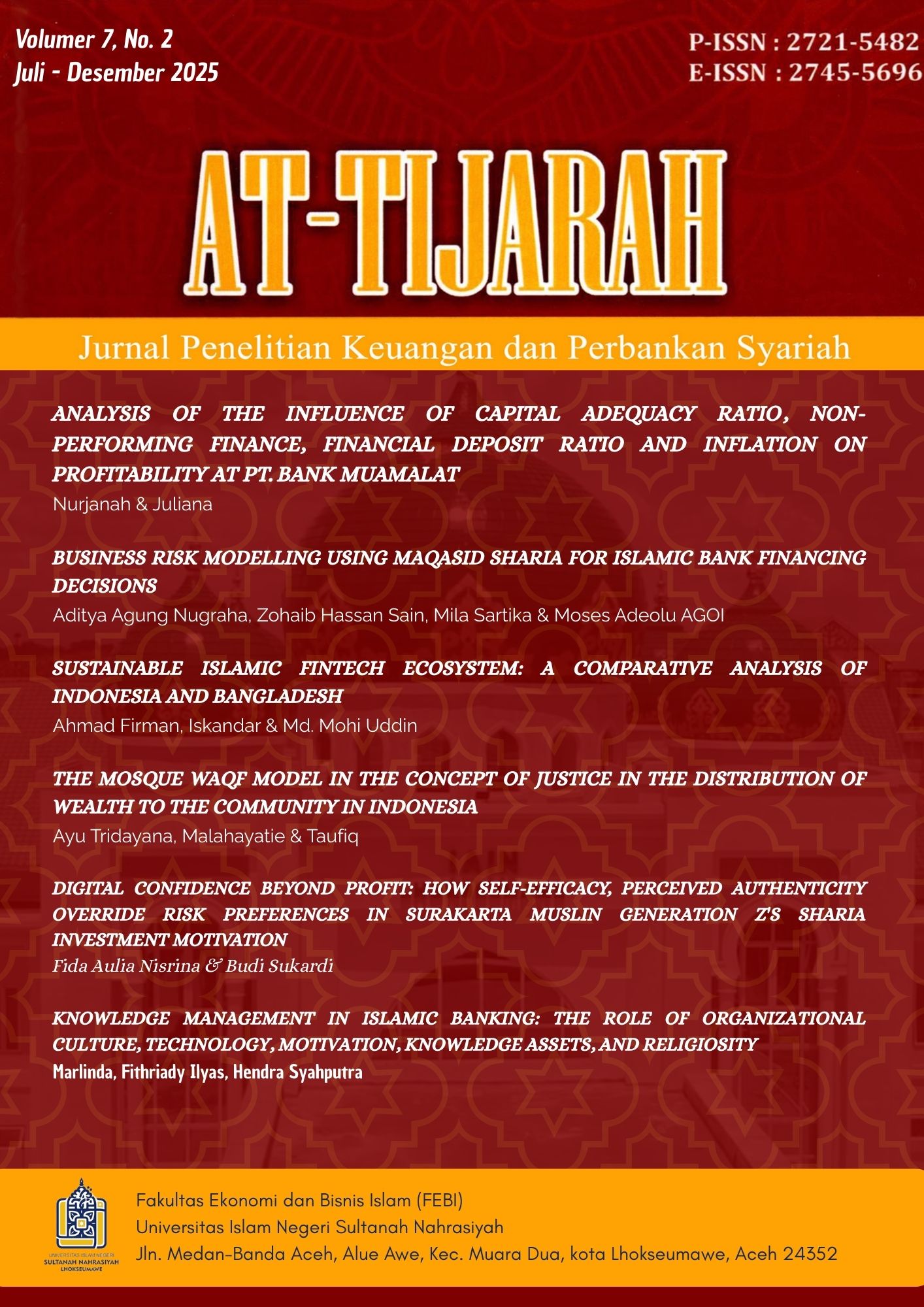
Digital Confidence Beyond Profit: How Self-Efficacy And Perceived Authenticity Override Risk Preferences In Muslim Generation Z's Sharia Investment Motivation In Surakarta
DOI:
https://doi.org/10.52490/at-tijarah.v7i2.6806Keywords:
Self-Efficacy, Risk Preference, Perceived Authenticity, Attitude, Motivation for Sharia Stock Investment, Generation ZAbstract
along with growing financial awareness and Islamic values, but their actual participation in the Islamic stock market remains relatively low compared to their demographic potential. This study aims to analyze the influence of self-efficacy, risk preference, and perceived authenticity on Islamic stock investment motivation, with attitude as a mediating variable among Generation Z Muslims in Surakarta City. This study used a quantitative method with an associative approach. Data were obtained from 194 respondents through an online questionnaire using a five-point Likert scale and analyzed using Structural Equation Modeling-Partial Least Square (SEM-PLS). The results showed that self-efficacy, perceived authenticity, and attitude had a significant positive effect on Islamic stock investment motivation, while risk preference had no significant effect. Attitude was proven to mediate the relationship between self-efficacy and perceived authenticity with Islamic stock investment motivation. These findings confirm that self-confidence and perceived product authenticity are more dominant than risk aversion in shaping investment motivation. The research implications emphasize the importance of increasing self-efficacy and perceptions of authenticity through transparency, halal certification, and digital education to increase Generation Z participation in sharia stock investment.
References
Annisa, R., Majid, M. S. A., Agustina, M., Nurdin, R., Sartiyah, S., & Riyaldi, M. H. (2023). Do Financial Literacy and Digital Technology Drive Investment Intention Among Gen Z in the Islamic Capital Market: A Mediating Role of Risk Tolerance. International Conference on Sustainable Islamic Business and Finance, SIBF 2023, 276–280. https://doi.org/10.1109/SIBF60067.2023.10379888
Arnum Puji Astuti,Malahayatie,Rahmawati. ANALISIS SWOT DAN BCG PADA PEMASARAN SYARIAH PADA USAHA KOPI DI KOTA TAKENGON, Jurnal Adz Dzahab Vol 9 no 2 tahun 2024. https://doi.org/10.47435/adz-dzahab.v9i2.3316
Bandura, A. (1997). Self-Efficacy_ The Exercise of Control. W.H. Freeman and Company.
Buana, D. T., & Amalia, N. (2025). Pengaruh Persepsi Risiko , Perilaku Keuangan , dan Pengetahuan Investasi Terhadap Keputusan Investasi pada Generasi Z di Kota Surakarta. Teewan Journal, 3(1), 1075–1090. https://doi.org/doi.org/10.62710/708p0x25
Chua, Y. P. (2023). a Step By Step Guide Smart Pls 4 Data Analysis. Researchtree Education. https://www.researchgate.net/publication/362790516_A_step-by-step_guide_PLS-SEM_data_analysis_using_SmartPLS_4
Dharma, Y., Puteh, A., Widodo, R., Alfaqih, L., & Yahya, A. (2024). The Influence of Financial Literacy and Islamic Business Ethics on Investment in Islamic Financial Instruments: The Mediating Role of Risk Attitude and The Moderating Role of Religious Knowledge. Journal of Ecohumanism, 3(8), 264–282. https://doi.org/10.62754/joe.v3i8.4729
Fitriyah, A. T., & Rahmawati, N. (2022). Digital Platform, Financial Literacy and Motivation on Generation Z’s Decision to Invest in Islamic Stocks: A Structural Equation Modelling Analysis. Muqtasid: Jurnal Ekonomi Dan Perbankan Syariah, 13(2), 112–126. https://doi.org/10.18326/muqtasid.v13i2.112-126
Hair, J. F., Hult, G. T. M., Ringle, C. M., Sarstedt, M., Danks, N. P., & Ray, S. (2022). Partial Least Squares Structural Equation Modeling. In Handbook of Market Research (Issue October 2023, pp. 587–632). Springer International Publishing. https://doi.org/10.1007/978-3-319-57413-4_15
Harjoni, H.Rahmawati , & Nola, S. L. (2025). Pengaruh Literasi Keuangan, Life Style, dan Locus Of Control Terhadap Perilaku Pengelolaan Keuangan Mahasiswa Ekonomi Syariah Febi Angkatan 2019. Jurnal BAABU AL-ILMI: Ekonomi dan Perbankan Syariah, 9(2), 173-179. https://doi.org/10.29300/ba.v9i2.5011
Hassan, N. C., Abdul-Rahman, A., Ab Hamid, S. N., & Mohd Amin, S. I. (2022). The Influence of Fintech Self-Efficacy on Investment Intention in Shariah-Compliant Unit Trusts in Malaysia. Jurnal Pengurusan, 66. https://doi.org/10.17576/pengurusan-2022-66-11
Hassan, N. C., Abdul-Rahman, A., Ab. Hamid, S. N., & Mohd Amin, S. I. (2024). What Factors Affecting Investment Decision? the Moderating Role of Fintech Self-Efficacy. PLOS ONE, 19(4), e0299004. https://doi.org/10.1371/journal.pone.0299004
Husin, M. M., Aziz, S., & Bhatti, T. (2023). The Impact of Brand Familiarity, Perceived Trust and Attitude on Investors’ Decision-Making in Islamic Stock Market Available to Purchase. Journal of Islamic Marketing, 14(8), 2009–2026. https://doi.org/10.1108/JIMA-04-2020-0093
Isti’anah, & Muhyarsyah. (2025). Comparative Analysis of Risk and Return of Sharia Stocks with Conventional Stocks. Research Horizon, 05(02), 97–108. https://doi.org/10.54518/rh.5.4.2025.767
Lestari, I. P., Ginanjar, W., & Warokka, A. (2021). Multidimensional Risk and Religiosity Towards Indonesian Muslims’ Sharia Investment Decision. Journal of Islamic Monetary Economics and Finance, 7(2), 369–400. https://doi.org/10.21098/jimf.v7i2.1321
Mabrur, I., & Agustina, A. (2025). Faktor-Faktor yang Mempengaruhi Kepercayaan Masyarakat terhadap Produk Investasi Syariah: Sebuah Tinjauan Literatur Article. Kafalah Jurnal Ekonomi, Manajemen, Dan Keuangan Syariah, 2, 65–80. https://doi.org/10.1234/kafalah.v2i1.40
Marpaung, M., Mujiatun, S., Husein, I., & Silalahi, P. R. (2020). The Behavior of Muslim Investors in Investing in Stocks on the Indonesia Stock Exchange During the COVID-19 Pandemic. Systematic Reviews in Pharmacy, 11(4), 745–752. https://doi.org/10.31838/srp.2020.4.109
Maslow, A. H. (1943). a Theory of Human Motivation (Vol. 50, Issue 13). https://doi.org/10.1037/h0054346
Nadeem, M. A., Qamar, M. A. J., Nazir, M. S., Ahmad, I., Timoshin, A., & Shehzad, K. (2020). How Investors Attitudes Shape Stock Market Participation in the Presence of Financial Self-Efficacy. Frontiers in Psychology, 11(October), 1–17. https://doi.org/10.3389/fpsyg.2020.553351
Noor, A. S. (2025). The Influence of Work Discipline and Work Environment on the Work Performance of Inpatient Nurses at Bhayangkara Hospital, Pontianak. International Journal of Business, Law, and Education, 6(1), 797–809. https://doi.org/10.56442/ijble.v6i1.1103
Normasyhuri, K., Saputri, Y. D., & Anggraeni, E. (2023). Generation Z Sharia investment decision patterns: Does information media matter? Jurnal Ekonomi & Keuangan Islam, 9(March 2020), 246–262. https://doi.org/10.20885/jeki.vol9.iss2.art7
Patrisia, D., Abror, A., Dastgir, S., & Rahayu, R. (2023). Generation Z’s Financial Behaviour: the Role of Islamic Financial Literacy. ISRA International Journal of Islamic Finance, 15(2), 20–37. https://doi.org/10.55188/ijif.v15i2.540
Puji Lestari, E., Lidya Putri Pertiwi, N., Alimuddin, A., & Asbihani, D. (2023). Minat Investasi Pekerja Migran Indonesia dalam Meningkatkan Ketahanan Ekonomi Keluarga di Lampung Timur. FINANSIA : Jurnal Akuntansi Dan Perbankan Syariah, 6(2621–4644), 2621–4636. https://doi.org/10.32332/finansia.v6i1.6630
Rahmawati, E., & Zuhroh, S. (2023). Pengaruh Perceived Authenticity terhadap Revisit Intention yang Dimediasi oleh Involvement (Studi pada Pelanggan Café Otentik di Jombang). Kompeten: Jurnal Ilmiah Ekonomi Dan Bisnis, 1(6), 285–289. https://doi.org/10.57141/kompeten.v1i6.38
Razak, S., Abdullah, I., & Raking, J. (2024). Factors Influencing the Behavioral Intention to Use Sharia Securities as an Investment. International Journal of Business and Society, 25(1), 91–110. https://doi.org/10.33736/ijbs.6902.2024
Razali, R., & Rahmawati, R. (2024). Hilirisation Agricultural Zakat as a Basis for Increasing Community Income. Management of Zakat and Waqf Journal (MAZAWA), 6(1), 1–18. https://doi.org/10.15642/mzw.2024.6.1.1-18
Ridwan, I. F. (2025). Analisis Faktor-Faktor yang Mempengaruhi Keputusan Investasi Syariah di Indonesia. La Zhulma | Jurnal Ekonomi Dan Bisnis Islam, 6(1), 51–60. https://doi.org/10.70143/lazhulma.v6i1.500
Rozak, A., Sari, M., Purnamasari, I., Anwar Zainol, F., & Author, C. (2024). Behavioral Finance in Sharia Investment: an Empirical Study on Indonesian Millennials. Journal of Islamic Economics and Business, 4(2), 2798–4834. https://journal.uinsgd.ac.id/index.php/jieb/article/view/46872
Septyanto, D., Unggul, U. E., Sayidah, N. S., & Assagaf, A. (2021). The Intention of Investors in Making Investment Decisions in Sharia Stocks : Empirical Study in Indonesian The Intention of Investors in Making Investment Decisions in Sharia Stocks : Empirical Study in Indonesian. Academic Journal of Interdisciplinary Studies, 10(July), 141–153. https://doi.org/10.36941/ajis-2021-0105
Siswanto. (2024). Religiosity and Entrepreneurial Motivation Roles in the Goal-Specific Relation: a Case of Muslim Students in Indonesia. Journal of Islamic Accounting and Business Research, 15(4), 701–725. https://doi.org/10.1108/JIABR-02-2022-0056
Venia, I., Yoesoef, Y., & Rahmawati (2024). Pengaruh Promosi, Gaya Hidup Dan Pekerja Terhadap Minat Masyarakat Menggunakan BSI LINK Di Kecamatan Muara Dua Kota Lhokseumawe. Borneo Islamic Finance and Economics Journal, 4(2), 99-113. https://doi.org/10.21093/bifej.v4i2.9441
Downloads
Published
How to Cite
Issue
Section
License
Copyright (c) 2025 Fida Aulia Nisrina, Budi Sukardi

This work is licensed under a Creative Commons Attribution-ShareAlike 4.0 International License.