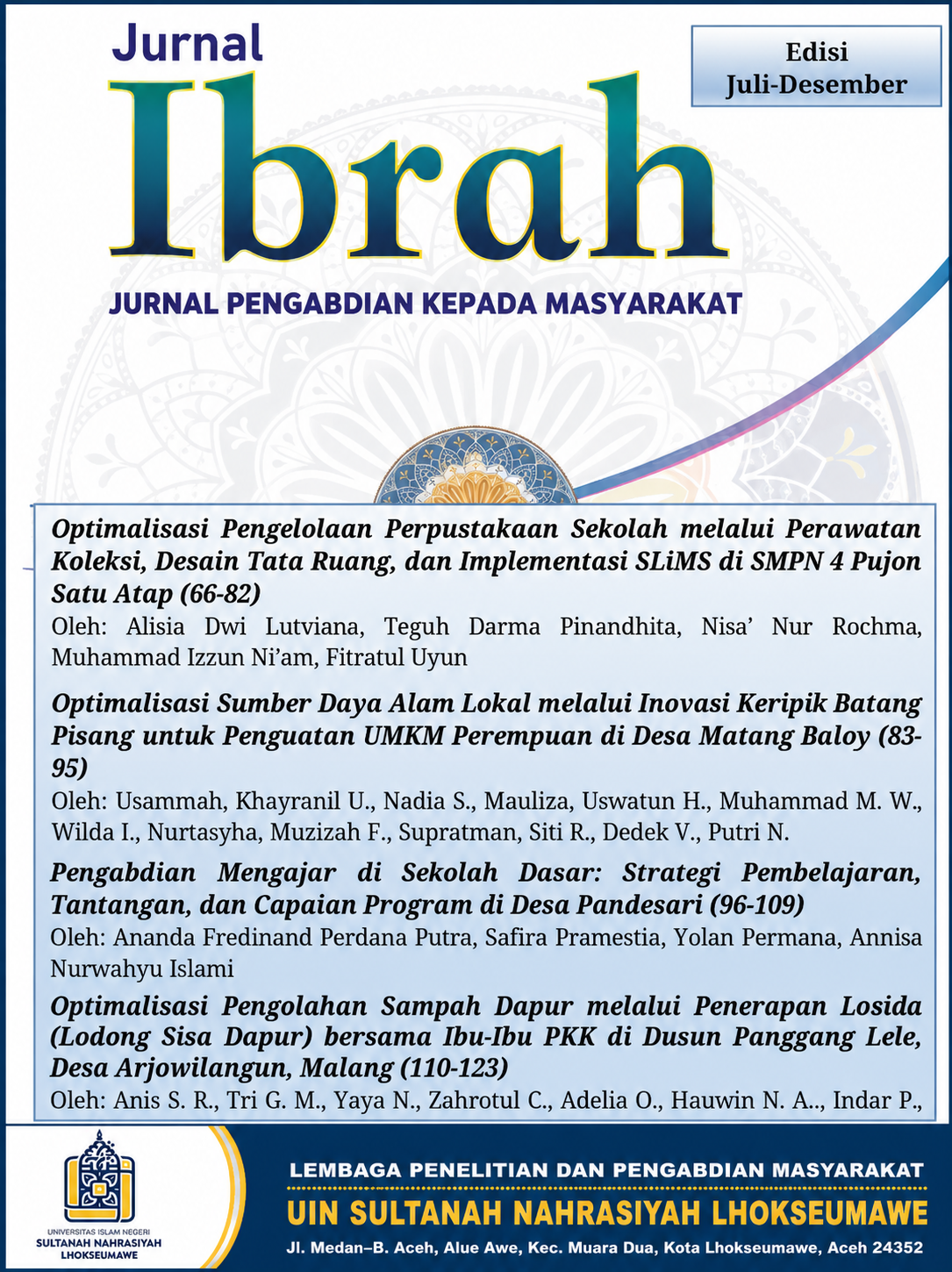
Optimalisasi Sumber Daya Alam Lokal melalui Inovasi Keripik Batang Pisang untuk Penguatan UMKM Perempuan di Desa Matang Baloy
DOI:
https://doi.org/10.47766/ibrah.v4i2.5914Keywords:
Banana Stem Chip Innovation, MSME Strengthening, Natural Resources, Women’s EmpowermentAbstract
Limited economic diversification in rural communities often results not from the absence of natural resources, but from insufficient community capacity to transform local potential into products with economic value. This community service program aims to optimize the natural resources of Matang Baloy Village through the development of micro, small, and medium enterprises (MSMEs) based on banana stem chip innovation as an effort to empower rural women. The program employed a Participatory Action Research (PAR) approach, actively involving the community—particularly groups of housewives—throughout the stages of problem identification, program planning, action implementation, and activity evaluation. Data were collected through participatory observation, focus group discussions, and continuous mentoring during the training and production processes. The results indicate an improvement in community knowledge and skills in processing banana stems into marketable food products, along with the growing readiness of women’s groups to develop home-based enterprises. Beyond generating product innovation, the program also encouraged positive changes in community attitudes toward the utilization of local natural resources that had previously been underused. The PAR approach played a crucial role in bridging the gap between natural resource potential and community capacity, while strengthening women’s roles as key economic actors at the village level. The conceptual model of PAR–natural resources–MSMEs–women’s empowerment developed in this program demonstrates that innovation based on local potential can serve as a sustainable empowerment instrument when supported by participatory processes.
References
Asnuryati, A. (2023). Strategi Pengembangan Ekonomi Berkelanjutan di Desa: Mendorong Pemberdayaan Komunitas dan Kemandirian Ekonomi Lokal. Innovative: Journal Of Social Science Research, 3(2), 2175-2183. http://j-innovative.org/index.php/Innovative/article/view/529.
Dijaya, I. G. N. A., & Ekasani, K. A. (2023). Keripik Berbahan Batang Pohon Pisang. Jurnal Ilmiah Pariwisata Dan Bisnis, 2(11), 2447–2451. https://doi.org/10.22334/paris.v2i11.616.
• Kemmis, S. (2006). Participatory Action Research and the Public Sphere. Educational Action Research, 14(4), 459-476. https://doi.org/10.1080/09650790600975593.
Kolb, D. A. (2014). Experiential Learning: Experience As the Source of Learning and Development. FT Press.
Ma'arif, M. F., Pratiwi, R., & Haryono, A. T. (2022). Analisis Orientasi Kewirausahaan dan Diversifikasi Produk pada Keberhasilan Usaha melalui Proses Perkembangan Usaha. Mbia, 21(3), 360-376. https://doi.org/10.33557/mbia.v21i3.1938.
Nufus, H., Nabila, A. M., Wahyuni, A., Hilwa, C., Febriana, N., Nirwana, I., ... & Hasami, M. (2024). Strategi Pengembangan Ekonomi Kreatif melalui Inovasi Keripik Kelapa: Studi Kasus Desa Blang Cut. Ibrah: Jurnal Pengabdian kepada Masyarakat, 3(2), 83-93. https://doi.org/10.47766/ibrah.v3i2.4835.
Patimah, N. E., Farhana, S. F., Meilana, V., Taha, S., Fadhilah, D., Assam, A., ... & Maallah, M. N. (2024). Pemberdayaan Ekonomi Perempuan Melalui Pengembangan Produk Keripik Batang Pisang di Desa Eran Batu. Jurnal Dedikasi Masyarakat, 7(2), 67-74. https://jurnal.umpar.ac.id/jdm/article/view/3151.
Rahmat, A., & Mirnawati, M. (2020). Model Participation Action Research dalam Pemberdayaan Masyarakat. Aksara: Jurnal Ilmu Pendidikan Nonformal, 6(1), 62–71. http://dx.doi.org/10.37905/aksara.6.1.62-71.2020.
Rani, S., Padmuji, M., Pratama, A., & Febyardalova, F. (2024). Pemberdayaan Ekonomi Masyarakat di Kampung Literasi Kelurahan Karyamulya melalui Inovasi Produk Keripik Pelepah Pisang. ADMA : Jurnal Pengabdian Dan Pemberdayaan Masyarakat, 5(1), 163–172. https://doi.org/10.30812/adma.v5i1.3517.
Ritonga, Z., Broto, B. E., Safri, H., & Hanum, F. (2022). Manfaat Pelepah Pisang Sebagi Makanan Ringan (Kripik Krispy Pelepah Pisang). Ika Bina En Pabolo: Pengabdian Kepada Masyarakat, 2(1), 16–21. https://doi.org/https://doi.org/10.36987/ikabinaenpabolo.v2i1.2506.
Sagajoka, E., Nona, R. V., Antonia, Y. N., & Gobhe, D. (2021). Peningkatan Ekonomi Masyarakat Desa Borani Melalui Inovasi Pengolahan Keripik Batang Pisang (BAPIS). Prima Abdika : Jurnal Pengabdian Masyarakat, 1(4), 136–143. https://doi.org/10.37478/abdika.v1i4.1257.
Sodiah, S., Fitri, D., Aziz, S. K., Nashikha, N. L., Mukni, R. M., Sari, I. Y., & Bashori, B. (2023). Pendampingan Usaha Mikro Kecil Menengah (UMKM) melalui Pemanfaatan Platform Digital di Desa Tambang Besi. Ibrah: Jurnal Pengabdian Kepada Masyarakat, 2(2), 67-82. https://doi.org/10.47766/ibrah.v2i2.1040.
Spradley, J. P. (1980). Participant Observation. Holt, Rinehart and Winston.
Une, S., Dahlan, S. A., & Saman, W. R. (2023). Pemanfaatan Limbah Batang Pisang Menjadi Produk Bernilai Jual Sebagai Upaya Peningkatan Ekonomi Masyarakat Desa Reksonegoro Kabupaten Gorontalo. Jurnal Pengabdian Masyarakat Teknologi Pertanian, 2(2), 207–214. https://ejurnal.ung.ac.id/index.php/jpmtp/article/view/23206.
Yuanti, Y., Rostianingsih, D., Khoirina, S., Solina, E., Antesty, S., Sabaruddin, E. E., ... & Jakarta, R. H. (2023). Pemberdayaan Perempuan melalui Program Pengabdian Masyarakat di Provinsi Jawa Tengah: Menciptakan Kesetaraan Gender dan Kesempatan Berwirausaha. Jurnal Pengabdian West Science, 2(06), 451-459. https://doi.org/10.58812/jpws.v2i6.449.
Zuber-Skerritt, O. (2011). Action Leadership: Towards a Participative Paradigm. Springer.
Downloads
Published
Issue
Section
License
Copyright (c) 2025 Muktar Isnan Hasibuan et al.

This work is licensed under a Creative Commons Attribution-ShareAlike 4.0 International License.