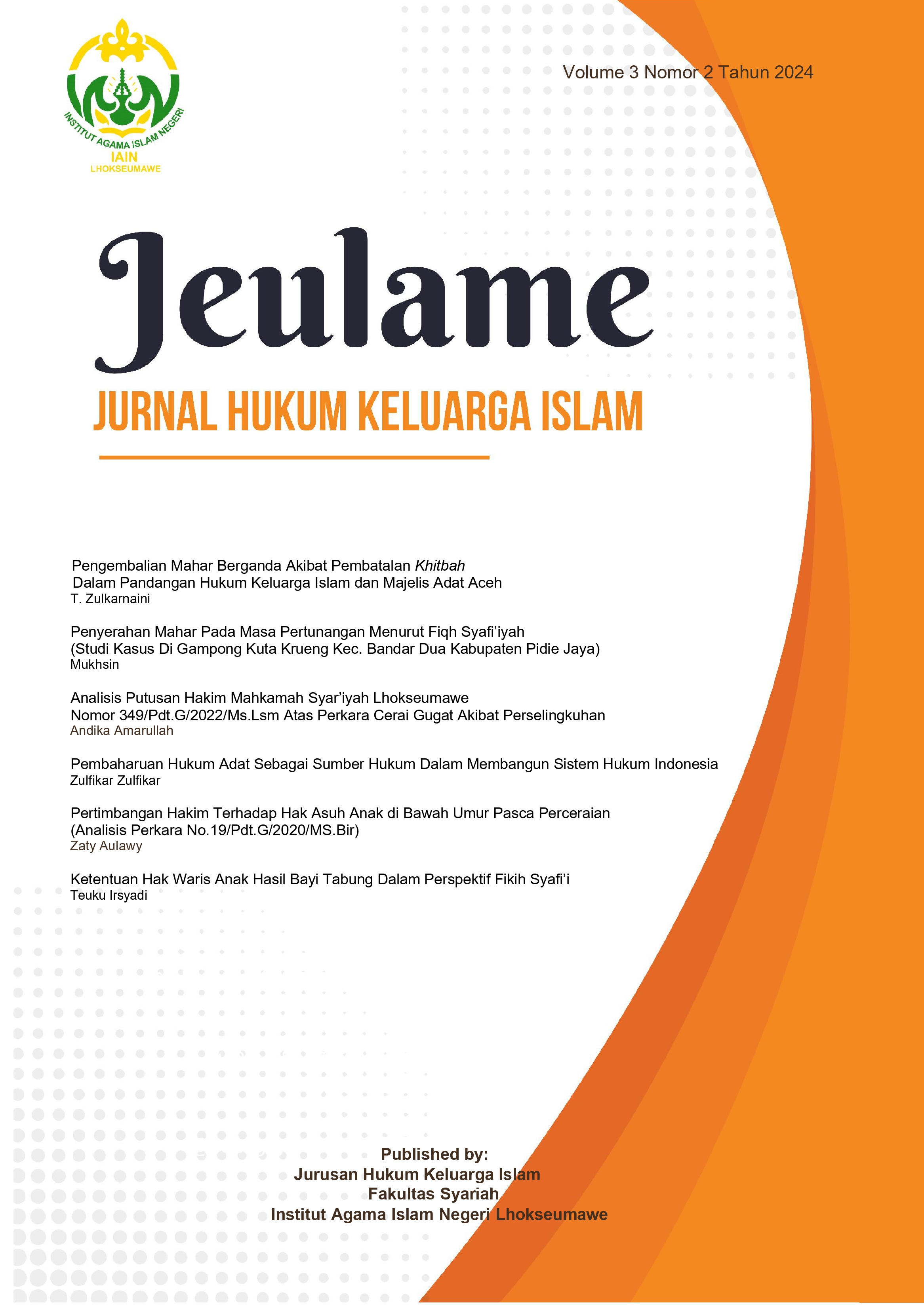
Pertimbangan Hakim Terhadap Hak Asuh Anak di Bawah Umur Pasca Perceraian (Analisis Perkara No.19/Pdt.G/2020/MS.Bir)
DOI:
https://doi.org/10.47766/jeulame.v3i2.3257Keywords:
Pertimbangan Hakim, Hak Asuh Anak, PerceraianAbstract
One such case occurred at the Bireuen Sharia Court, where a divorced couple fought over child custody. During the divorce proceedings, the child lived with his mother, but after the father took the child and did not return him to his mother, a dispute arose, and the wife sued her ex-husband to regain custody of the child. Based on Law No. 1 of 1974 concerning marriage, it is explained that when a child is not yet mumayyiz, custody of the child is granted to the mother. However, in the above case, the panel of judges decided that custody of the child, who was not yet mumayyiz, should be granted to the biological father. The research questions are 1) what criteria did the judge use in determining custody of the minor child after divorce, and 2) what legal considerations did the panel of judges use in decision No. 19/Pdt.G/2020/MS.Bir regarding the determination of custody of the minor child after divorce. The objectives of this study are to explain the criteria used by judges in determining custody of minors after divorce and to describe the legal considerations used by the panel of judges in decision No. 19/Pdt.G/2020/MS.Bir regarding custody of minors after divorce at the Bireuen Sharia Court. The research method used in this study is a descriptive comparative empirical normative legal approach, beginning with legislation and legal events that have occurred. The data sources used in this study are primary and secondary data sources with primary legal materials, secondary legal materials, and non-legal materials, then data collection techniques by analyzing decision No.19/Pdt.G/2020/MS.Bir and the data analysis technique used is content analysis. Based on the results of the study, it shows that 1) the criteria used by judges in determining custody of minors after divorce include: legal certainty, factual truth, the principle of justice, legal interpretation, legal context and objectives, precedent, and the arguments of the parties, 2) the legal considerations used by the panel of judges were that the father was deemed more capable and entitled to care for his child materially, mentally, and morally because the mother had behaved abusively towards the child while the child was living with her and had married another man.
References
Ahmad, Idris. Fiqh Menurut Madzhab Sjafi’i. Jakarta: Widiaya, 1999.
Fuad, Muhammad. Fiqh Wanita Lengkap. Jombang: Lintas Media, 2007.
Idhamy, Dahlan. Azas-Azas Fiqh Munakahat. Surabaya: ALIkhlas, 1984.
Kurtubi, Mashuri. Menikah Itu Indah. Jakarta: Insan Madani, 2007.
Muhaimin. Metode Penelitian Hukum. Edited by Fatia Hijriyanti. Mataram University Press. Mataram: Mataram University Press, 2020.
Nur, Djamaan. Fiqh Munakahat. Semarang: Dina Utama Thoha Putra Group, 1993.
Tim Penyusun. Undang-Undang Republik Indonesia Nomor 1 Tahun 1974 Tentang Perkawinan Dan KHI. Bandung: Grahamedia Press, 2014.
Zein, Satria Effendi M. Problematika Hukum Keluarga Islam Kontemporer. Jakarta: Kencana, 2004.
Downloads
Published
Issue
Section
License
Copyright (c) 2025 Zaty Aulawy

This work is licensed under a Creative Commons Attribution-ShareAlike 4.0 International License.