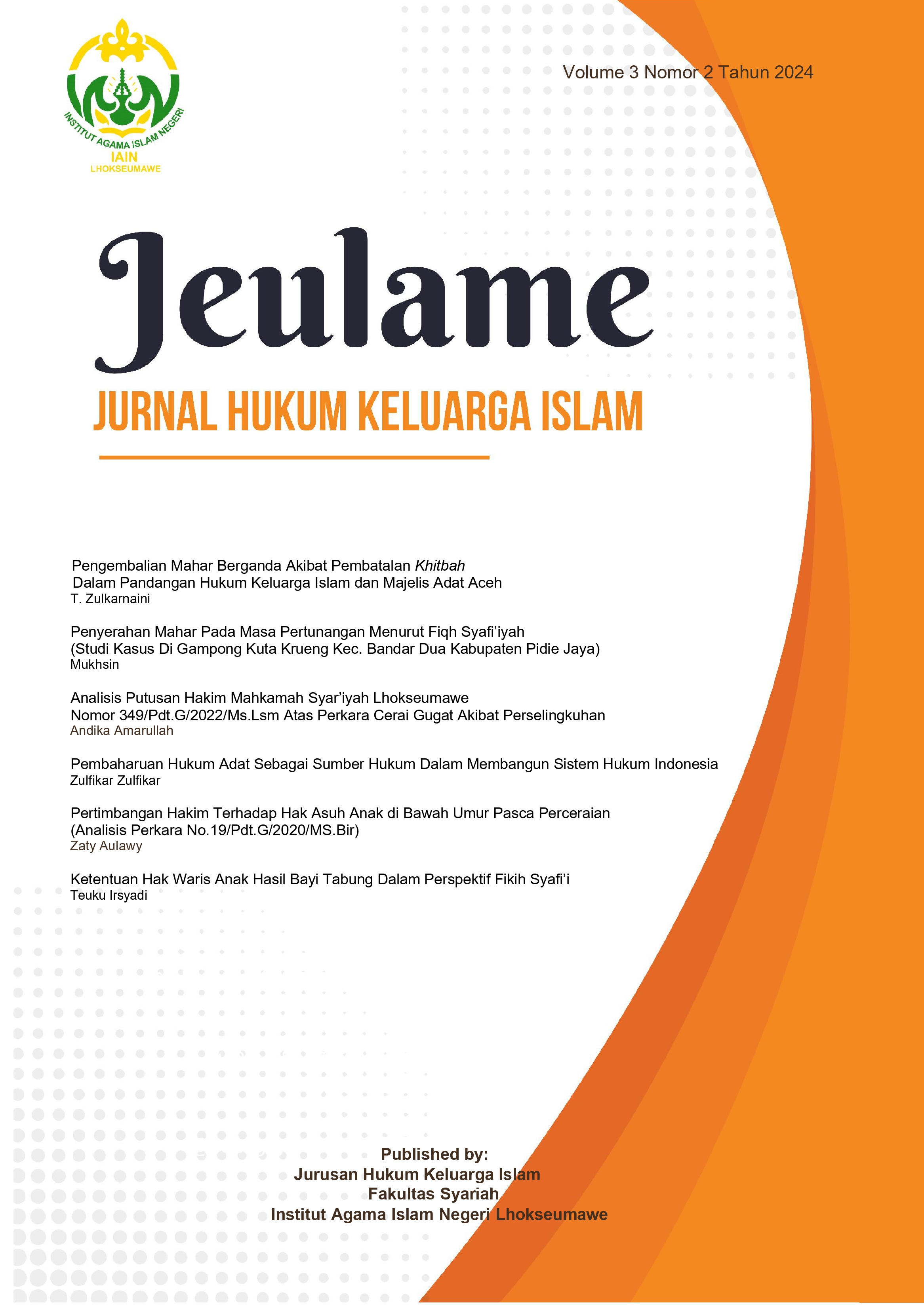
Ketentuan Hak Waris Anak Hasil Bayi Tabung Dalam Perspektif Fikih Syafi’i
DOI:
https://doi.org/10.47766/jeulame.v3i2.3268Keywords:
Hak Waris, Bayi Tabung, Fikih Syafi’iAbstract
A child resulting from artificial insemination or IVF is a child born due to the process of fusion of sperm and ovum without sexual intercourse, then processed in the tube (outside the uterus), after fertilization occurs and the embryo or zygote is sown into the woman's uterus. The problem in this study concerns the right of inheritance of IVF children. This study is a literature study using qualitative methods that produce descriptive data. The source of data is in the form of secondary data obtained from the results of research and several previous journals related to this study. The sources of secondary data that the author uses in this study are various books and books of contemporary jurisprudence related to this research problem. As for the results of this study, the practice of IVF can be classified into two kinds, namely the practice of IVF in accordance with the Shari'a and not in accordance with the Shari'a. As for the practice of IVF in accordance with the Shari'a, that is, if the seed comes from a legitimate husband and wife, then the child from the results of the practice of IVF can inherit from both parents by Islamic Family Law. As for the practice of IVF yangtidak in accordance with Shari'a Islamic Family Law the child from the results of the practice of IVF can not inherit from his father but can inherit from the mother who has given birth to child.
References
Al-Bukhari, Ṣaḥīḥ al-Bukhārī, (Kairo: Darul Hadis, 2009).
Ali Akbar, Seksualita ditinjau dari Hukum Islam, (Jakarta: Pustaka Mantik, 2000)
Ali parman, Kewarisan dalam al-qur‟an: suatu kajian dengan pendekatan tafsir tematik, (Jakarta: Raja grafindo persada,1995)
Al-Nawawi, Rawḍat al-Ṭālibīn, Juz VII (Beirut: Dar al-Fikr, 1993).
Dahlan, Ensiklopedia Hukum Islam, (Jakarta: Raja Grafindo, 2010)
Departemen Agama Republik Indonesia, Al-Qur’an dan Terjemahnya, (Bandung: Diponegoro, 2011).
Ibn Manzur, Lisān al-‘Arab, Jilid XIII (Beirut: Dar Sadir, 1990).
Kamaluddin Nurdin Marjuni, Kamus Syawarifiyyah: Kamus modern sinonim Arab- Indonesia (Ciputat : Ciputat press grouf , 2009)
Mahmud syaltut, Al Fatawa, Cairo : Darul Qalam, tt.
Mestika Zed, Metode Penelitian Kepustakaan, (Jakarta: Yayasan Obor Indonesia, 2004)
Muhammad Abu Zahrah, Uṣūl al-Fiqh (Kairo: Dar al-Fikr al-‘Arabi, 1958).
Muhammad Alî al-Shâbûnî, Al-Mawarits fi Asy-Syariah Al-Islamiyyah, diterjemahkan Hamdan Rasyid, Hukum Kewarisan Menurut Al-Qur'an dan Sunnah, Cet. I; (Jakarta: Dar Al-Kutub Al- Islamiyah, 2005)
Muhammad ibn Idris al-Syafi’i, Al-Umm, Juz VII.
Nashiruddin Abdullah Ibn Umar al-Baidhawi, Anwār al-tanzīl wa asrār al-ta’wīl, Jd.IV, (Beirut: dar ihya’ turats, 1418)
Octa Dwienda Ristika dan Widyo Juliarti, Prinsip Etika Dan Moralitas Dalam Pelayanan Kebidanan (Yogyakarta: CV Budi Utama, 2012)
Suparman Usman, S.H, Fiqh Mawaris (Jakarta: Gaya Media Pratama, 1997)
Undang-undang Nomor 1 tahun 1974 tentang Perkawinan, pasal 1
Wahbah az-Zuhaili, Al-Fiqh al-Islami wa Adillatuh, Jilid VIII.
Yahya ibn Syaraf al-Nawawi, Al-Majmū‘ Syarḥ al-Muhaẓẓab, Juz XVII (Beirut: Dar al-Fikr, 1995).
Downloads
Published
Issue
Section
License
Copyright (c) 2025 Teuku Irsyadi

This work is licensed under a Creative Commons Attribution-ShareAlike 4.0 International License.