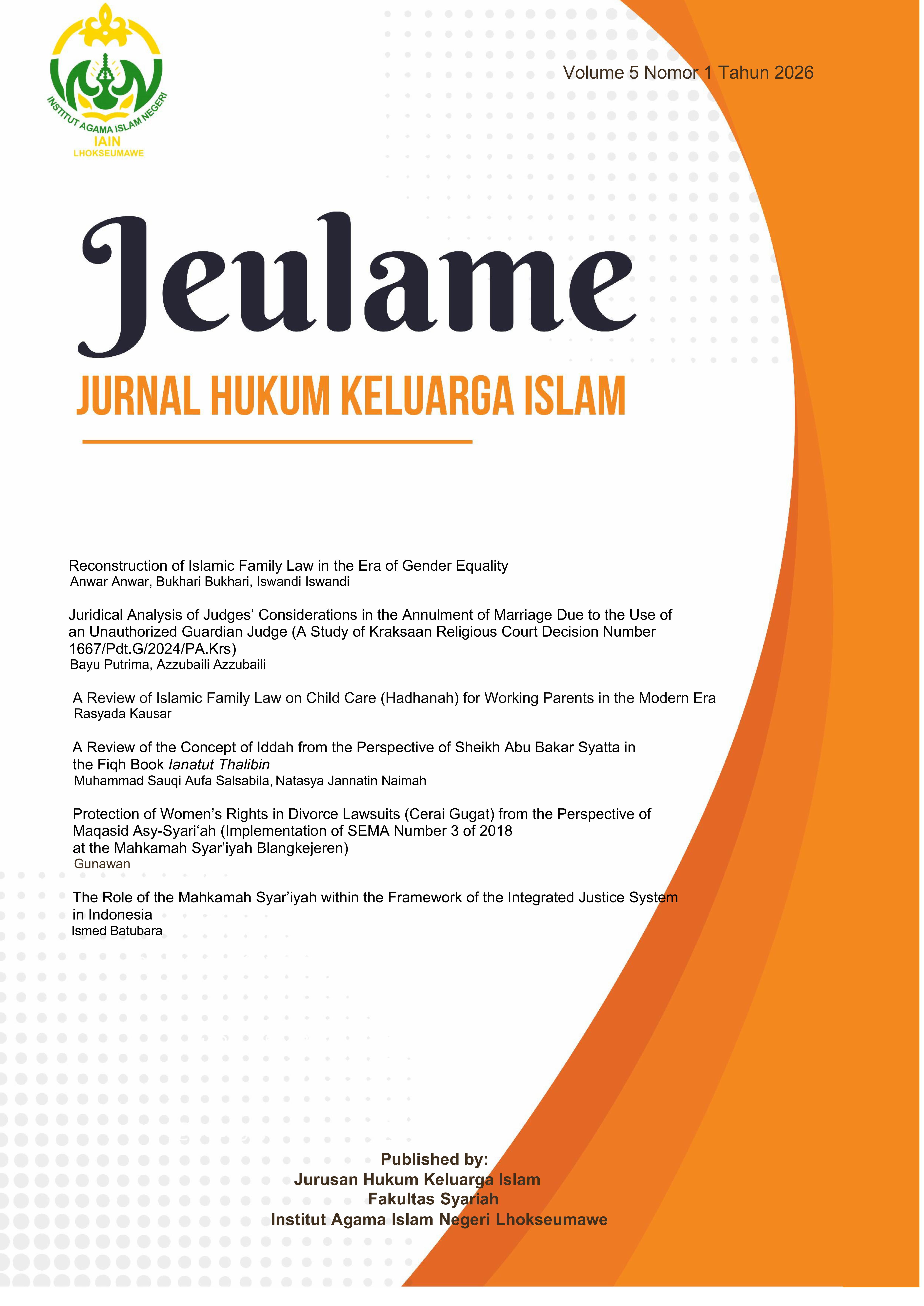
A Review of the Concept of Iddah from the Perspective of Sheikh Abu Bakar Syatta in the Fiqh Book Ianatut Thalibin
DOI:
https://doi.org/10.47766/jeulame.v5i1.7575Keywords:
Iddah, Syekh Abu Bakar Syatta, Ianatut ThalibinAbstract
Marriage in Islam is a sacred bond that is comprehensively regulated, but when the bond is broken through divorce or the death of the husband, Islamic law stipulates the provisions of iddah as a form of protection of women's rights after separation. This study aims to examine and analyze the concept of iddah from the perspective of Sheikh Abu Bakar Syatta in the fiqh book Ianatut Thalibin, including the definition, legal basis, types of iddah, provisions of ihdad, women's obligations during the iddah period, and differences of opinion between schools of thought regarding the meaning of quru'. This study starts from the assumption that the thoughts of Sheikh Abu Bakar Syatta as a great scholar of the 19th century Shafi'i school offer detailed, comprehensive, and contextual explanations of various iddah issues in real life, as well as relevant to answer contemporary legal challenges. This study uses a qualitative library research method with a normative descriptive-analytical approach. The primary data source is the book Ianatut Thalibin, especially the section discussing iddah, while secondary sources include fiqh books, journals, and related scientific works. The results of the study show that iddah has a strong basis in the Qur'an, hadith, and the consensus of scholars, with different provisions for the period according to the condition of women. The difference in interpretation of the meaning of quru' between the Shafi'i and Hanafi schools is a khilafiyah that both have a strong scientific basis, but the opinion of the Shafi'i school that interprets quru' as a pure period is considered more relevant because it is more in line with the objectives of the iddah law itself.
References
Al-Dimyathi, Syekh Abu Bakar Syatha. I’anah Al-Thalibin, Juz IV. Beirut: Dar al Fikr, n.d.
al-Malibari, Syekh Zainuddin. Fathul Mu’in Bi Sharh Qurratul ’Ain Bi Muhimmat Al-Din. Edited by Aliy As’ad. Kudus: Menara Kudus, 1980.
Asmawi, Asmawi. “Konseptualisasi Teori Maslahah.” SALAM: Jurnal Sosial Dan Budaya Syar-I 1, no. 2 (2014). https://doi.org/10.15408/sjsbs.v1i2.1548.
Azra, Azyumardi. Jaringan Ulama Timur Tengah Dan Kepulauan Nusantara. Jakarta: Kencana, 2013.
Basri, Rusdaya. Fikih Munakahat 2. Parepare: IAIN Parepare Nusantara Press, 2020.
Hanafiah, Mahmudi. “’Iddah Perempuan Kematian Suami:(Analisis Hadis-Hadis Tentang ’Iddah Karena Kematian Suami).” Ameena Journal 2, no. 1 (2024): 35–50. https://ejournal.ymal.or.id/index.php/aij/article/view/50.
Hayati, Zakiyah. “Pengaturan Talak Dan ‘Iddah (Studi Komparatif Prespektif Fikih Empat Mazhab Dan Kompilasi Hukum Islam (KHI)).” Qiyas 2, no. 1 (2017): 49–59.
Khitam, Husnul. “Nafkah Dan Iddah: Perspektif Hukum Islam.” Az Zarqa’ 12, no. 2 (2020): 189–205.
Khoiri, Ahmad, and Asyharul Muala. “‘Iddah and Ihdād for Career Women from Islamic Law Perspective.” Journal of Islamic Law 1, no. 2 (2020): 256–73. https://doi.org/10.24260/jil.v1i2.71.
Kholid, and Abdul Aziz. “PROBLEMATIKA IDDAH DAN IHDAD (Menurut Madzhab Syafi’i Dan Hanafi).” Al-Insyiroh: Jurnal Studi Keislaman 1, no. 1 (2015): 117–33. https://doi.org/10.35309/alinsyiroh.v1i1.3344.
Masyhuri, A. Aziz. Biografi Ulama Nusantara. Surabaya: Santri Salaf Press, 2015.
Munir, Anggita Putri, Aliya Wandari. “ULAMA-ULAMA PENYEBAR AGAMA ISLAM DI KAWASAN.” Jurnal Multidisiplin Inovatif 9, no. 12 (2025): 315–22.
Nawawi, Al. Raudhah Al Thalibin. Beirut: Dar al-Kutub al-Ilmiah, 2013.
Nisa, Khairatun, Muhammad Amar Adly, and Heri Firmansyah. “Kaidah Fiqhiyyah Yang Berkaitan Dengan Masalah ‘Iddah.” Albayan Journal of Islam and Muslim Societies 1, no. 02 (2024): 60–74.
NU Online. “Kitab Kifayatul Atqiya’: Mengenal Tarekat Secara Komprehensif.” NU Online, 2024. https://nu.or.id/pustaka/kitab-kifayatul-atqiya-mengenal-tarekat-secara-komprehensif-Lrobx.
Nuha, Ulin. “Analisis Pendapat Madzhab Hanafi Tentang Iddah Wanita Yang Belum Haid (Studi Kitab Bada’i Al-Shona’i Fi Tartibi Al-Syaro’i).” Universitas Islam Negeri (UIN) Walisongo, Semarang, 2016.
Saefi, Ahmad Zamzam. “Iddah Dalam Mazhab Fiqih Dan Perundangan Indonesia.” El-Faqih : Jurnal Pemikiran Dan Hukum Islam 9, no. 1 (2023): 126–41. https://doi.org/10.58401/faqih.v9i1.963.
Santoso, Dri. “PEMIKIRANIMAM SYAFI’I TENTANG KETENTUAN QURU’ DALAM SURAT AL-BAQARAH AYAT 228 DAN RELEVANSINYA.” Jurnal Mabahits; Jurnal Hukum Keluarga 2, no. 01 (2021): 13–28.
Shodiqin, Mohammad. “IMPLEMENTASI KETENTUAN MASA IDDAH WANITA MENOPAUSE DI KABUPATEN KEDIRI.” Al-Syakhshiyyah: Jurnal Hukum Keluarga Islam Dan Kemanusiaan 6, no. 2 (2024). https://doi.org/https://doi.org/10.30863/as-hki.v6i2.7288.
Syarifuddin, Amir. Hukum Perkawinan Islam Di Indonesia, Antara Fiqh Munakahat Dan Undang-Undang Perkawinan. Jakarta: Kencana, 2007.
Wijaya, M. Tatam. “Hak Dan Kewajiban Perempuan Selama Masa Iddah.” NU Online, 2019. https://islam.nu.or.id/nikah-keluarga/hak-dan-kewajiban-perempuan-selama-masa-iddah-DE3LX.
Zuhaili, Wahbah Al. Fiqh Al Islam Wa Adillatuhu. Edited by Abdul Hayyie Al Kattani dkk. Jakarta: Gema Insani, 2011.
———. Fiqh Al Islam Wa Adillatuhu Volume X. Dimasyq: Dar al Fikr, n.d.
Zuhdi, Masyfuk. Masail Fiqhiyyah. Jakarta: Haji Mas Agung, 1991.
Downloads
Published
Issue
Section
License
Copyright (c) 2026 Muhammad Sauqi, Aufa Salsabila, natasya jannatin naimah

This work is licensed under a Creative Commons Attribution-ShareAlike 4.0 International License.