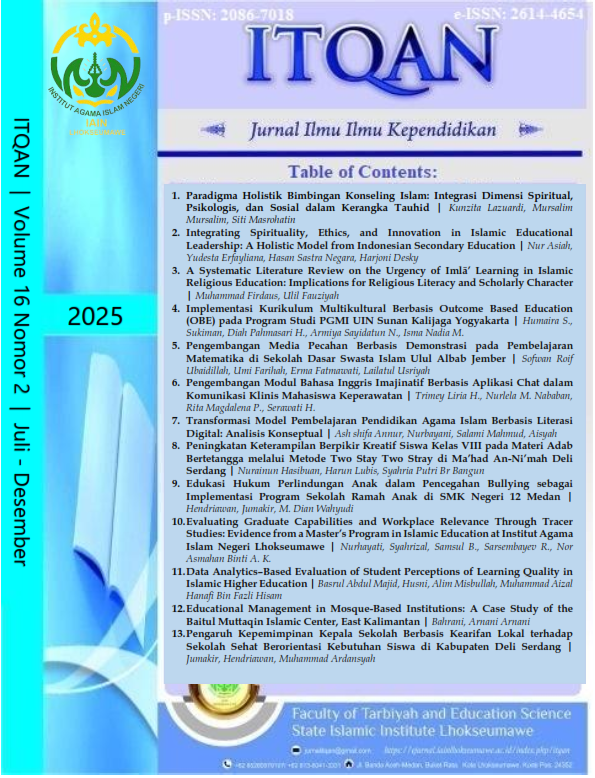
Data Analytics–Based Evaluation of Student Perceptions of Learning Quality in Islamic Higher Education
DOI:
https://doi.org/10.47766/itqan.v16i2.6305Keywords:
Assessment Transparency, Islamic Higher Education, Learning Quality, Student PerceptionAbstract
This study employs an integrated data analytics approach to examine student perceptions of learning quality at the Faculty of Islamic Economics and Business (FEBI), IAIN Lhokseumawe. The analytical framework combines descriptive statistics, K-Means clustering, and multiple linear regression to provide a comprehensive evaluation of instructional quality. Data were collected from 805 active undergraduate students using a structured questionnaire measuring nine learning quality indicators related to instructional delivery, lecturer competence, communication, assessment practices, and institutional compliance. The findings indicate that students generally perceive the quality of learning positively, with an overall mean score of 4.32 on a five-point Likert scale. Lecturer’s Mastery of Material and Accuracy in Answering Questions emerged as the highest-rated indicators, while Material Suitability with the Semester Learning Plan (RPS) and Transparency of Assessment Criteria received comparatively lower scores. Regression results show that instructional quality indicators significantly influence overall student satisfaction, with assessment transparency as the strongest predictor and material suitability with the RPS as the weakest. These results highlight the importance of transparent assessment practices and consistent alignment between instructional materials and the RPS in shaping students’ learning experiences, enhancing student trust, reducing uncertainty, and sustaining educational quality in Islamic higher education.
Downloads
References
Ashraf, M. A., Amir, T., & Ahmed Ratan, S. R. (2025). Effects of Faculty Psychological Empowerment and Autonomy on Sustainable Quality Education in the Didactics of Accreditation and Green Pedagogy. Journal of Global Responsibility. https://doi.org/10.1108/jgr-10-2023-0170.
Creswell, J. W., & Creswell, J. D. (2018). Research Design: Qualitative, Quantitative, and Mixed Methods Approaches (5th ed.). Thousand Oaks, CA: Sage Publications.
Daniel, B. K. (2014). Big Data and Analytics in Higher Education: Opportunities and Challenges. British Journal of Educational Technology, 46(5), 904–920. https://doi.org/10.1111/bjet.12230.
DeVellis, R. F. (2017). Scale Development: Theory and Applications (4th ed.). Thousand Oaks, CA: Sage Publications.
Dong, Y. (2023). Teaching Quality Monitoring and Evaluation in Higher Education Through a Big Data Analysis. International Journal of Emerging Technologies in Learning (Ijet), 18(08), 61–78. https://doi.org/10.3991/ijet.v18i08.39247.
Elkins, R. L., & McDade, R. (2021). Student Perception of Online Learning Experiences Associated With COVID-19. Research Directs in Health Sciences, 1(1). https://doi.org/10.53520/rdhs2021.10419.
Ferguson, R. (2012). Learning Analytics: Drivers, Developments and Challenges. International Journal of Technology Enhanced Learning, 4(5/6), 304. https://doi.org/10.1504/ijtel.2012.051816.
Field, A. (2018). Discovering Statistics Using IBM SPSS Statistics (5th ed.). London: Sage Publications.
Fraenkel, J. R., Wallen, N. E., & Hyun, H. H. (2019). How to Design and Evaluate Research in Education (10th ed.). New York: McGraw-Hill Education.
He, J., Lin, K.-Y., & Dai, Y. (2023). A Data-Driven Innovation Model of Big Data Digital Learning and Its Empirical Study. Information Dynamics and Applications, 1(1), 35–43. https://doi.org/10.56578/ida010105,
Han, J., Kamber, M., & Pei, J. (2022). Data Mining: Concepts and Techniques (4th ed.). Burlington, MA: Morgan Kaufmann.
Hod, R., Maimon, O., & Zimlichman, E. (2019). Measuring the Academic Value of Academic Medical Centers: Describing a Methodology for Developing an Evaluation Model at One Academic Medical Center. Israel Journal of Health Policy Research. https://doi.org/10.1186/s13584-019-0334-4.
Kaliisa, R., Kluge, A., & Mørch, A. I. (2022). Overcoming Challenges to the Adoption of Learning Analytics at the Practitioner Level: A Critical Analysis of 18 Learning Analytics Frameworks. Scandinavian Journal of Educational Research, 66(3), 367–381. https://doi.org/10.1080/00313831.2020.1869082.
Kero, A. A., & Endebu, A. (2023). The Role of Big Data Analytics in Improving Teacher Training in Developing Countries: A Literature Review. https://doi.org/10.21203/rs.3.rs-3111391/v1.
Likert, R. (1932). A Technique for the Measurement of Attitudes. Archives of Psychology.
MacQueen, J. (1967). Some Methods for Classification and Analysis of Multivariate Observations. In Proceedings of the Fifth Berkeley Symposium on Mathematical Statistics and Probability (pp. 281–297). Berkeley, CA: University of California Press.
Mardi, Ekohariadi, Setiadiningsih, A., Anifah, L., & Wardhono, A. (2024). The Effectiveness of Differentiated Learning Using Personalized Approach to the Employability of Vocational High School Students in the Animation Study Program. Journal of Law and Sustainable Development, 12(3), e2565. https://doi.org/10.55908/sdgs.v12i3.2565.
Murumba, J., & Micheni, E. (2017). Big Data Analytics in Higher Education: A Review. The International Journal of Engineering and Science, 06(06), 14–21. https://doi.org/10.9790/1813-0606021421.
Mustapha, I., Rattanawiboonsom, V., & Intanon, R. (2023). Data-Driven Insights in Higher Education: Exploring the Synergy of Big Data Analytics and Mobile Applications. International Journal of Interactive Mobile Technologies (Ijim), 17(20), 21–37. https://doi.org/10.3991/ijim.v17i20.45037.
Muthmainnah, M., Siripipatthanakul, S., Apriani, E., & Yakin, A. A. (2023). Effectiveness of Online Informal Language Learning Applications in English Language Teaching: A Behavioral Perspective. Education Science and Management, 1(2), 7. https://doi.org/10.56578/esm010202.
Ndukwe, I. G., & Daniel, B. K. (2020). Teaching Analytics, Value and Tools for Teacher Data Literacy: A Systematic and Tripartite Approach. International Journal of Educational Technology in Higher Education, 17(1). https://doi.org/10.1186/s41239-020-00201-6.
Nunnally, J. C., & Bernstein, I. H. (1994). Psychometric Theory (3rd ed.). New York: McGraw-Hill.
Shashidhar, V., K, Y. R., Haleagrahara, N., Woolley, T., Alele, F., & Malau‐Aduli, B. S. (2019). Factors Influencing Medical Students’ Experiences and Satisfaction With Blended Integrated E-Learning. Medical Principles and Practice, 29(4), 396–402. https://doi.org/10.1159/000505210.
Syed, S., & Albalawi, E. (2024). Harnessing Big Data and Data Science for Enhanced Efficiency in Higher Education: An Exhaustive Review and Assessment. https://doi.org/10.21203/rs.3.rs-4283540/v1.
Tawafak, R. M., Alyoussef, I. Y., & Al-Rahmi, W. M. (2023). Essential Factors to Improve Student Performance Using an E-Learning Model: Review Study. International Journal of Interactive Mobile Technologies (Ijim), 17(03), 160–176. https://doi.org/10.3991/ijim.v17i03.35727.
Togher, M., & Fenech, M. (2020). Ongoing Quality Improvement in the Context of the National Quality Framework: Exploring the Perspectives of Educators in ‘Working Towards’ Services. Australasian Journal of Early Childhood, 45(3), 241–253. https://doi.org/10.1177/1836939120936003.
Downloads
Published
How to Cite
Issue
Section
License
Copyright (c) 2025 Basrul Abdul Majid, Husni, Alim Misbullah, Muhammad Aizal Hanafi Bin Fazli Hisam

This work is licensed under a Creative Commons Attribution-ShareAlike 4.0 International License.