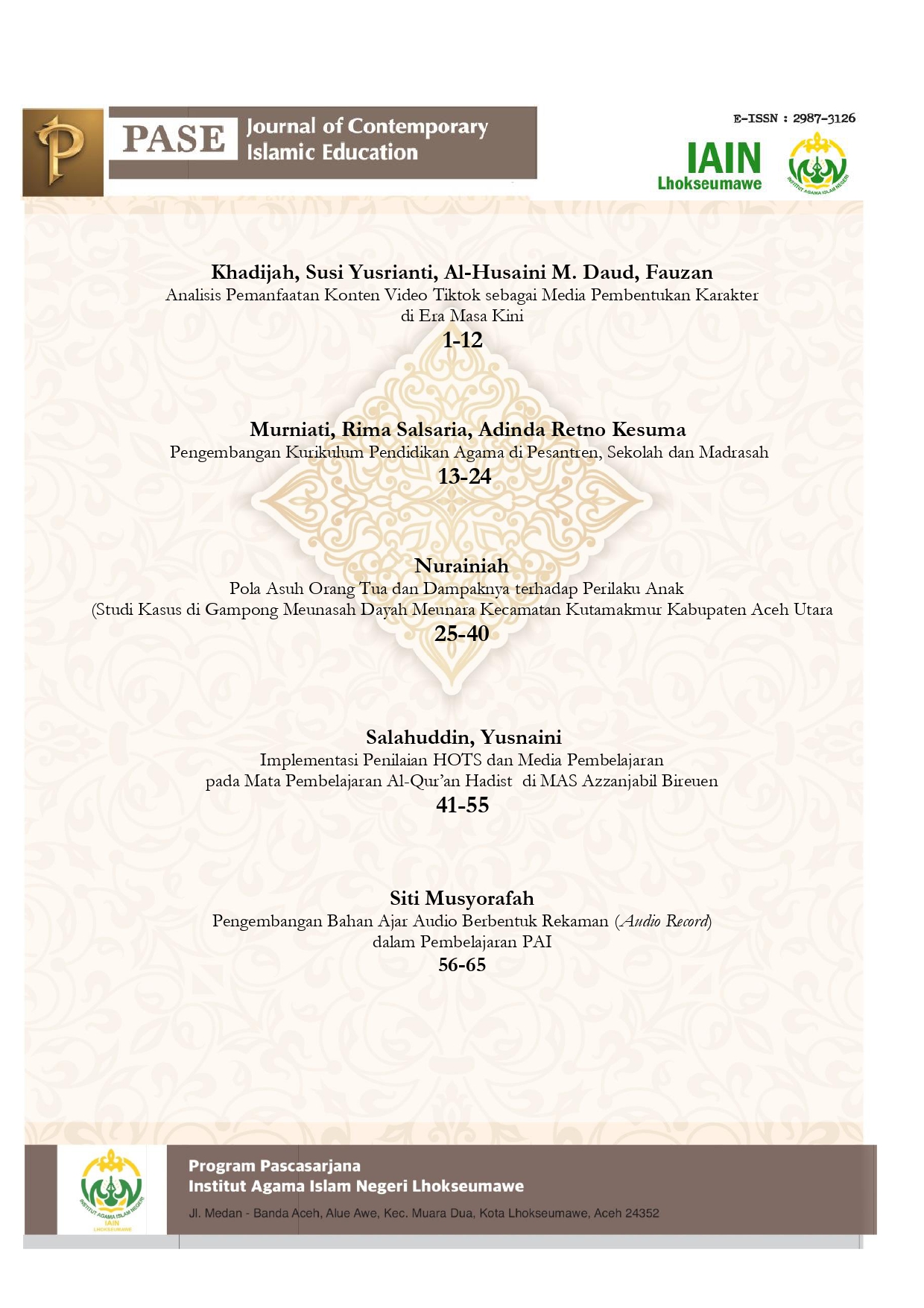
Implementasi Penilaian HOTS dan Media Pembelajaran pada Mata Pembelajaran Al-Qur’an Hadis di MAS Azzanjabil Bireuen
DOI:
https://doi.org/10.47766/pase.v2i2.2514Keywords:
21st-Century Learning, Al-Qur’an Hadis, HOTS Assessment, Instructional MediaAbstract
Assessment based on Higher Order Thinking Skills (HOTS) and the use of instructional media are two essential components of 21st-century learning. In the context of the Al-Qur’an Hadis subject, both play a vital role in fostering students’ critical, creative, and contextual thinking abilities. However, the implementation of HOTS and instructional media at the Madrasah Aliyah still faces various challenges, particularly in terms of teachers’ understanding and classroom practices. This study employs a qualitative approach using a case study method. Data were collected through in-depth interviews, participatory observation, and document analysis involving Al-Qur’an Hadis teachers at MAS Azzanjabil Bireuen. Thematic analysis was conducted using descriptive-analytical techniques, and data validity was strengthened through source and method triangulation. The findings indicate that teachers have a reasonably good understanding of HOTS and instructional media. They can articulate the principles of HOTS-based assessment and utilize media such as YouTube, laptops, and projectors in their teaching practices. However, the implementation of HOTS questions remains inconsistent due to concerns about student workload and technical limitations. HOTS-based assessment and instructional media should not be viewed merely as technical tools, but as pedagogical strategies that enhance the quality of learning and support teacher professionalism. This study offers both conceptual and practical contributions to the development of Al-Qur’an Hadis instruction that aligns with the demands of 21st-century education.
References
Anggoro, D., Khudori, M. S., Saufi, M., Indra, M., & Anwar, K. (2023). Media Pembelajaran dalam Perspektif Al-Qur’an Dan Hadist. Journal of Student Research, 1(5), 286-306. https://doi.org/10.55606/jsr.v1i5.1727.
Arsyad, A. (2014). Media Pembelajaran. Jakarta: Rajawali Pers.
Braun, V., & Clarke, V. (2006). Using Thematic Analysis in Psychology. Qualitative Research in Psychology, 3(2), 77–101. https://doi.org/10.1191/1478088706qp063oa.
Brookhart, S. M. (2010). How to Assess Higher-Order Thinking Skills in Your Classroom. Alexandria, VA: ASCD.
Carel, G., Jusniani, N., & Monariska, E. (2021). Kemampuan Higher Order Thinking Skills dalam Pembelajaran Metakognitif Ditinjau dari Persepsi Siswa. PYTHAGORAS: Jurnal Matematika dan Pendidikan Matematika, 16(2), 204-216. https://doi.org/10.21831/pythagoras.v16i2.37926.
Creswell, J. W. (2014). Research Design: Qualitative, Quantitative, and Mixed Methods Approaches (4th ed.). Thousand Oaks, CA: Sage Publications.
Fanani, M. Z. (2018). Strategi Pengembangan Soal HOTS pada Kurikulum 2013. Edudeena: Journal of Islamic Religious Education, 2(1), 57-76. https://doi.org/10.30762/ed.v2i1.582.
Hamzah, B. U. & Lamatenggo, N. (2011). Strategi Pembelajaran: Menciptakan Proses Belajar Mengajar yang Efektif. Jakarta: Bumi Aksara.
Hidayat, U. S. (2016). Model-model pembelajaran efektif. Bina Mulia Publishing.
Khoiriyah, S., Faizin, M., Asror, M., & Kusaeri, K. (2023). Research Trends in School Excellent Model (SEM): The Future Insights for Islamic Education Assessment. QALAMUNA: Jurnal Pendidikan, Sosial, dan Agama, 15(2), 907-922. https://doi.org/10.37680/qalamuna.v15i2.3143.
Majit, A., & Miski, M. (2023). Pembelajaran al-Qur’an Secara Digital: Pergeseran Sistem Isnad dan Peneguhan Otoritas Baru. Jurnal SMART (Studi Masyarakat, Religi, Dan Tradisi), 9(1), 133-146. https://doi.org/10.18784/smart.v9i1.1795.
Mu'minatin, N., & Zarkasi, Z. (2023). Pengembangan Media Pembelajaran Berbasis Android Pada Mata Pelajaran Al-Qur’an Hadits Madrasah Aliyah. Al-Qalam: Jurnal Kajian Islam dan Pendidikan, 15(1), 66-79. https://doi.org/10.47435/al-qalam.v15i1.2013.
Patton, M. Q. (2002). Qualitative Research and Evaluation Methods (3rd ed.). Thousand Oaks, CA: Sage Publications.
Qutsiyah, D. A., Asy’ari, H., Fadhillah, F., Sirojuddin, A., & Nasucha, J. A. (2022). Analisis Materi Ajar Pendidikan Agama Islam dan Budi Pekerti SMP Kelas VIII Perspektif Hots. Attadrib: Jurnal Pendidikan Guru Madrasah Ibtidaiyah, 5(2), 145-157. https://doi.org/10.54069/attadrib.v5i2.287.
Rosyada, D. (2017). Madrasah dan profesionalisme guru dalam arus dinamika pendidikan Islam di era otonomi daerah. Kencana.
Sara, S., Suhendar, S., & Pauzi, R. Y. (2020). Analisis Higher Order Thinking Skills (HOTS) Siswa Kelas VIII pada Materi Sistem Pernapasan Manusia. Bioedusiana: Jurnal Pendidikan Biologi, 5(1), 52–61. https://doi.org/10.34289/bioed.v5i1.1654
Yin, R. K. (2018). Case Study Research and Applications: Design and Methods (6th ed.). Thousand Oaks, CA: Sage Publications.
Downloads
Published
Issue
Section
License
Copyright (c) 2023 Salahuddin Abdullah, Yusnaini

This work is licensed under a Creative Commons Attribution-ShareAlike 4.0 International License.