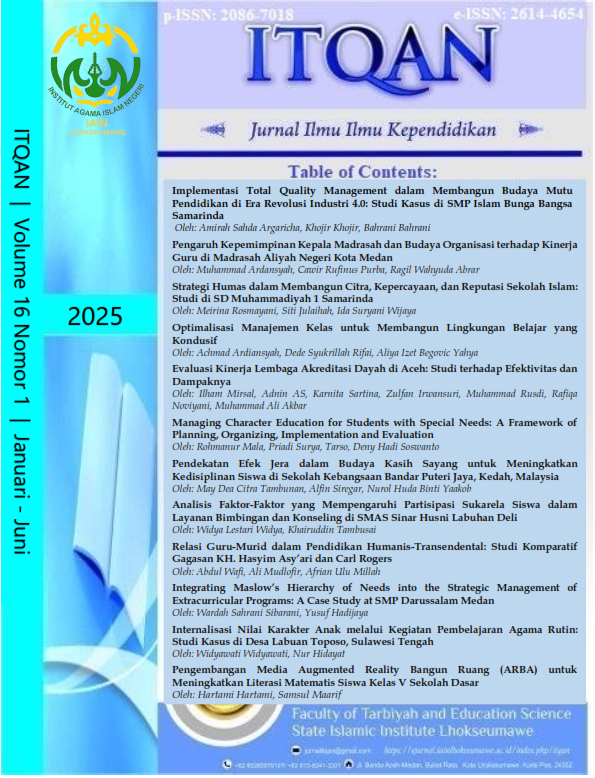
Implementasi Total Quality Management dalam Membangun Budaya Mutu Pendidikan di Era Revolusi Industri 4.0: Studi Kasus di SMP Islam Bunga Bangsa Samarinda
DOI:
https://doi.org/10.47766/itqan.v16i1.2880Keywords:
Educational Quality Culture, Industrial Revolution 4.0, Total Quality Management, Quality ImprovementAbstract
This study aims to analyze the implementation of Total Quality Management (TQM) in building a culture of quality education during the Industrial Revolution 4.0 era at SMP Islam Bunga Bangsa Samarinda. In the context of global transformations demanding innovative and adaptive education systems, schools are required to deliver services that prioritize continuous improvement and stakeholder satisfaction. This research employed a qualitative approach with a case study method. Data were collected through in-depth interviews, participatory observations, and document analysis of the school's quality management policies and practices. The findings indicate that the implementation of TQM at SMP Islam Bunga Bangsa Samarinda includes strategic efforts such as improving the quality of teaching and administrative staff, optimizing academic and non-academic services, integrating technology into teaching and administration, and strengthening communication with parents. The success of TQM implementation is supported by visionary leadership, a sustainable performance evaluation system, and reward mechanisms that enhance staff motivation. The resulting quality culture has had a positive impact on student achievement, graduate competence, and overall parental satisfaction. Nonetheless, challenges include intergenerational differences among teachers, a lack of alignment between foundation policies and school operational strategies, and difficulties in maintaining teaching quality due to sudden staff turnover. The study concludes that TQM is effective in fostering a sustainable quality culture in the era of the industrial revolution, if it is supported by synergy across school components and responsive policy frameworks.
Downloads
References
Asnawan, A. (2021). Enhancement Integrated Quality Management in Islamic Education Institutions. Bulletin of Science Education, 1(1), 45–66. https://doi.org/10.51278/bse.v1i1.108.
Daft, R. L. (2015). Organization Theory and Design (12th ed.). Cengage Learning Canada Inc.
Deming, W. E. (1986). Principles for Transformation: Out of the Crisis. MIT Press.
Dokumentasi Profil SMP Islam Bunga Bangsa Samarinda. (2024). Internal School Report. Samarinda: SMP-IBB.
Garvin, D. A. (1988). Managing Quality: The Strategic and Competitive Edge. The Free Press.
Goetsch, D. L., & Davis, S. B. (2016). Quality Management for Organizational Excellence: Introduction to Total Quality. New Jersey: Pearson.
Hangsing, P. (2010). Kano Model's Perspective of Library 2.0 Concept. https://aisel.aisnet.org/sprouts_all/357/.
Juran, J. M. (1999) Juran's Quality Handbook. McGraw-Hill.
Lewin, K., & Cartwright, D. (1953). Field Theory in Social Science: Selected Theoretical Papers. Harper & Row, Publisher. Inc.
Manatos, M. J., Sarrico, C. S., & Rosa, M. J. (2017). The Integration of Quality Management in Higher Education Institutions: A Systematic Literature Review. Total Quality Management & Business Excellence, 28(1–2), 159–175. https://doi.org/10.1080/14783363.2015.1050180.
Miles, M. B., Huberman, A. M., & Saldaña, J. (2014). Qualitative Data Analysis: A Methods Sourcebook (3rd ed.). SAGE Publications.
Oakland, J. S. (2003). Total Quality Management: Text with Cases. Routledge.
Patton, M. Q. (2002). Qualitative Research & Evaluation Methods (3rd ed.). Sage Publications.
PISA (2022) Results (Volume I and II) - Country Notes: Indonesia. https://www.oecd.org/en/publications/pisa-2022-results-volume-i-and-ii-country-notes_ed6fbcc5-en/indonesia_c2e1ae0e-en.html.
Robbins, S. P., & Coulter, M. (2018). Management (14th ed.). Pearson Education Inc.
Trilling, B., & Fadel, C. (2009). 21st Century Skills: Learning for Life in Our Times. John Wiley & Sons.
UNESCO. (2019). Framework for the Future of Learning: The Competency Framework for Teachers in the Era of Digital Transformation. Paris: UNESCO.
https://unesdoc.unesco.org/ark:/48223/pf0000370936.
Salabi, A. S., Prasetyo, M. A. M., Halil, H., & Maulina, M. (2024). Effectiveness of the Islamic Education Management Study Program Using Alumni Tracer Study Data. Jurnal Akuntabilitas Manajemen Pendidikan, 12(2), 1-16. https://doi.org/10.21831/jamp.v12i2.71426.
Sallis, E. (2010). Manajemen Mutu Terpadu Pendidikan, terj. Ahmad Ali Riyadi dan Fahrurrozi. IRCiSoD.
Syafri, H. M., Ramadhansyah, M. M., Salabi, A. S., & Putra, A. (2025) Kepemimpinan SDM di Sekolah dan Kampus. CV. Bravo Press Indonesia
Yin, R. K. (2015). Studi Kasus Desain dan Metode. Cetakan ke-14, PT. RajaGrafindo Persada, Jakarta.
Downloads
Published
How to Cite
Issue
Section
License
Copyright (c) 2025 Amirah Sahda Argaricha, Khojir Khojir, Bahrani Bahrani

This work is licensed under a Creative Commons Attribution-ShareAlike 4.0 International License.