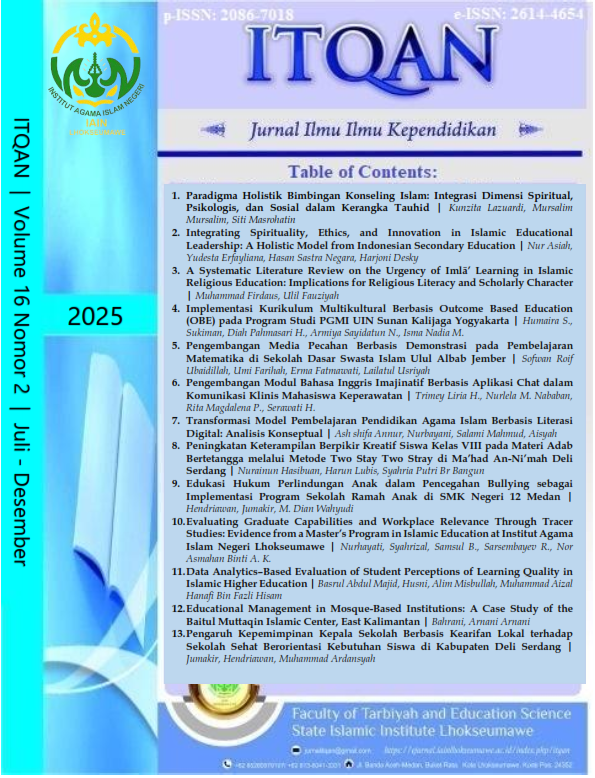
A Systematic Literature Review on the Urgency of Imlā’ Learning in Islamic Religious Education: Implications for Religious Literacy and Scholarly Character
DOI:
https://doi.org/10.47766/itqan.v16i2.5063Keywords:
Imlā’ Learning, Islamic Religious Education, Scholarly Character, Systematic Literature ReviewAbstract
Imlā’ instruction plays a central role in Islamic Religious Education by strengthening Arabic writing accuracy and supporting religious literacy. However, existing studies tend to emphasize its technical outcomes, while the pedagogical, affective, and epistemological dimensions that position imlā’ as a practice shaping scholarly awareness have not been sufficiently synthesized. This study aims to examine the urgency of imlā’ learning and its contribution to learners’ academic competence and scholarly character through a Systematic Literature Review (SLR). Following PRISMA guidelines, this review analyzed 21 peer-reviewed studies published between 2015 and 2025. Data were collected from Scopus, SINTA, DOAJ, and Google Scholar and systematically analyzed to identify research designs, imlā’ methods, and learning outcomes. The findings indicate that most studies consistently report positive effects of imlā’ instruction on Arabic writing accuracy, including improved letter formation, orthographic precision, and reduced imlā’iyyah errors. Several studies also highlight affective benefits, such as increased focus, discipline, and learning responsibility, while a smaller number of studies address persistent challenges in academic writing accuracy at higher education levels. The integration of digital media remains limited and functions primarily as a supportive tool rather than a replacement for manual writing practice. Overall, the review confirms that imlā’ instruction is not merely a technical exercise but a foundational pedagogical practice that contributes to religious literacy, disciplined learning habits, and scholarly character.
Downloads
References
Al-Qabisi, A. H. A. (1986). Al-Risalah al-Mufassalah li-Ahwal al-Muta‘allimin wa-Ahkam al-Mu‘allimin wa’l-Muta‘allimin. Ed. Ahmad Khalid. Al-Sharikah al-Tunisiyyah.
Braun, V., & Clarke, V. (2006). Using Thematic Analysis in Psychology. Qualitative Research in Psychology, 3(2), 77–101. https://doi.org/10.1191/1478088706qp063oa.
Cahyaningsih, P. S., & Fuad, A. F. N. (2024). Implikasi Pembelajaran Khot Imla’terhadap Keterampilan Menulis Al-Qur’an Siswa Madrasah Aliyah Kudus. Attractive: Innovative Education Journal, 6(1), 139-147. https://attractivejournal.com/index.php/aj/article/view/1101.
Dawolo, S. R., Tanjung, Y. F., Zega, I. P. S., Zebua, A. I., & Budianti, Y. (2024). Evolusi Institusi Pendidikan Islam Klasik: Masjid, Kuttāb, dan Madrasah. Jurnal Sains Dan Teknologi, 6(3), 279-286. http://ejournal.sisfokomtek.org/index.php/saintek/article/view/3573.
Dewey, J. (1974). John Dewey on Education: Selected Writings. University of Chicago Press.
Fahriyan, W. (2023). Imla’ as an Innovative Memorization Method in Qur’an-Hadith Learning. Abjadia : International Journal of Education, 8(2), 108–116. https://doi.org/10.18860/abj.v8i2.22912.
Fahruddin, M. M. (2010). Kuttab: Madrasah pada Masa Awal (Umayyah) Pendidikan Islam. Madrasah: Jurnal Pendidikan dan Pembelajaran Dasar, 2(2), 207-221. https://doi.org/10.18860/JT.V2I2.1822.
Freire, P. (2020). Pedagogy of the Oppressed. In Toward a Sociology of Education (pp. 374-386). Routledge.
Ghofur, M. A., & A’ini, C. (2022). Pelatihan Penulisan dengan Metode Imla’di Ponpes As-Sunniyyah Jember. An-Nuqtah, 1(2), 57–62. https://ejournal.uas.ac.id/index.php/An-Nuqthah/article/view/626.
Hadi, M., & Machmudah, U. (2023). Analysis Study of the "Tracing the Dots" Method in IMLA Learning for Students Ma’had Al-Izzah Leadership School Batu. Risalah: Jurnal Pendidikan Dan Studi Islam, 9(2), 565–575. https://www.jurnal.faiunwir.ac.id/index.php/Jurnal_Risalah/article/view/510.
Hasan, L. M. U., & Machmudah, U. (2022). Imla’ Learning Media by Using Youtube for Prospective Students at Gontor Islamic Boarding School Darussalam. Proceedings of the International Symposium on Religious Literature and Heritage (ISLAGE 2021), 644(Islage 2021), 65–69. https://doi.org/10.2991/assehr.k.220206.008.
Hatami, A., & Amrulloh, M. A. (2025). Improving Arabic Writing Skills Through The Effectiveness of Imla’ Manzhūr Learning. Al-Ta’rib : Jurnal Ilmiah Program Studi Pendidikan Bahasa Arab IAIN Palangka Raya, 13(1), 45–58. https://doi.org/10.23971/altarib.v13i1.9893.
Imam, A. & Halim Abdul. (2021). Efektivitas Metode Imla’ terhadap Peningkatan Kemampuan Siswa dalam Menulis Bahasa Arab. EL-IBTIKAR: Jurnal Pendidikan Bahasa Arab, 113–125. https://doi.org/10.24235/IBTIKAR.V10I2.9304.
Khaldun, I. (2014). The Muqaddimah: An Introduction to History. The Anthropology of Climate Change: An Historical Reader, 55-66. https://doi.org/10.1002/9781394260881.ch3.
Mahmudi, M., Lutfi, S., & Hikmah, N. (2025). Kemampuan Menulis Ayat Al-Qur’an Mahasiswa PAI dalam Mata Kuliah Khat Imla’ di IAIN Palangka Raya. EDUCATIONAL : Jurnal Inovasi Pendidikan & Pengajaran, 5(1), 177–186. https://doi.org/10.51878/educational.v5i1.4714.
Nida, A., Sida, A., Amin, N., & Malla, A. B. (2022). Penerapan Metode Imla’ terhadap Kemampuan Menulis Bahasa Arab Siswa MA As’adiyah Makassar. Karya Ilmiah Mahasiswa (KIMA), 1(2), 87–96. https://jurnal.fs.umi.ac.id/index.php/KIMA/article/view/447.
Nugraha, R. M., Bahar, R., & Fatimah, T. S. (2024). Pengaruh Penekanan Kaidah Imla dalam Kemampuan Menulis Bahasa Arab (Imla’). Jazirah: Jurnal Peradaban Dan Kebudayaan, 5(01), 1–19. https://doi.org/10.51190/jazirah.v5i01.114.
Nur’aini, R., Aini, Q., & Irianti, Q. (2024). Pengaruh Pembelajaran Berbasis Literasi terhadap Kemampuan Menulis Siswa dalam Materi Pendidikan Agama Islam. EduSpirit: Jurnal Pendidikan Kolaboratif, 1(1), 858–863. https://journal.makwafoundation.org/index.php/eduspirit/article/view/1251.
Panagara, F. H., Ghofur, M. A., & Bangki, H. R. L. (2023). Analisis Kesalahan Penulisan pada Abstrak Skripsi Berbahasa Arab dalam Perspektif Kaidah Imla’. Takuana: Jurnal Pendidikan, Sains, Dan Humaniora, 2(2), 90–100. https://doi.org/10.56113/takuana.v2i2.77.
Putri, A. S. A. & Taufik, T. (2024). Meningkatkan Keterampilan Menulis Bahasa Arab Melalui Strategi Pembelajaran Imla’. Mahira, 4(1), 35–50. https://doi.org/10.55380/mahira.v4i1.921.
Putri, S. Y., & Nursholihah, A. F. (2024). Efektivitas Metode Imla’ dalam Peningkatan Keterampilan Menulis pada Pembelajaran Bahasa Arab di Madrasah Diniyyah Takmiliyah Awaliyah Al-Haqq. Socius: Jurnal Penelitian Ilmu-Ilmu Sosial, 2(1), 41–44. https://doi.org/10.5281/zenodo.13235253.
Ramayanti, R., Rachmawati, N. A., Azhar, Z., & Nik Azman, N. H. (2023). Langkah Demi Langkah Systematic Literature Review dan Meta-Analysis. PT. Raja Grafindo Persada.
Rasyidi, A. (2024). Kontribusi Majelis Pendidikan dalam Meningkatkan Standar Pendidikan: Tinjauan Strategi dan Implementasi di Sekolah. Multidisciplinary Research Review, 1(1), 19–32. https://barkah-ilmi-fiddunya.my.id/ojs/index.php/au/article/view/54.
Rosyad, M. S., & Haq, M. A. (2024). Problematika dan Solusi Pembelajaran Dikte Bahasa Arab (IMLA’) pada Siswa Madrasah Ibtidaiyah Darul Ulum Gresik. Al-Lahjah : Jurnal Pendidikan, Bahasa Arab, Dan Kajian Linguistik Arab, 7(1), 731–739. https://doi.org/10.32764/allahjah.v7i1.4245.
Ulum, F., & Mariah, E. (2017). Tadris Al-Imla' bi al-'Arabiyah li al-Nathiqin bi Ghairiha Musykilatuhu Wa Hululuhu. Arabi: Journal of Arabic Studies, 2(1), 93–104. http://dx.doi.org/10.24865/ajas.v2i1.27.
Zubaidah, N. L. (2022). Implementasi Metode Pembelajaran Imla’ Dalam Meningkatkan Kemampuan Menulis Huruf Arab Siswa Taman Pendidikan Al-Qur’an Hidayatullah Jomblang, Takeran, Magetan. Tesis Institut Agama Islam Negeri Ponorogo.
Zulfa, I. & El-Syam, R. S. (2024). Implementasi Metode Imla’ Manqul dalam Meningkatkan Kemampuan Menulis Huruf Arab di TPQ Tanwirut-Thullab Panikel, Kampung Laut, Cilacap. Jurnal Manajemen Dan Pendidikan Agama Islam, 2(4), 240–248. https://doi.org/10.61132/jmpai.v2i4.404.
Downloads
Published
How to Cite
Issue
Section
License
Copyright (c) 2025 Muhammad Firdaus, Ulil Fauziyah

This work is licensed under a Creative Commons Attribution-ShareAlike 4.0 International License.