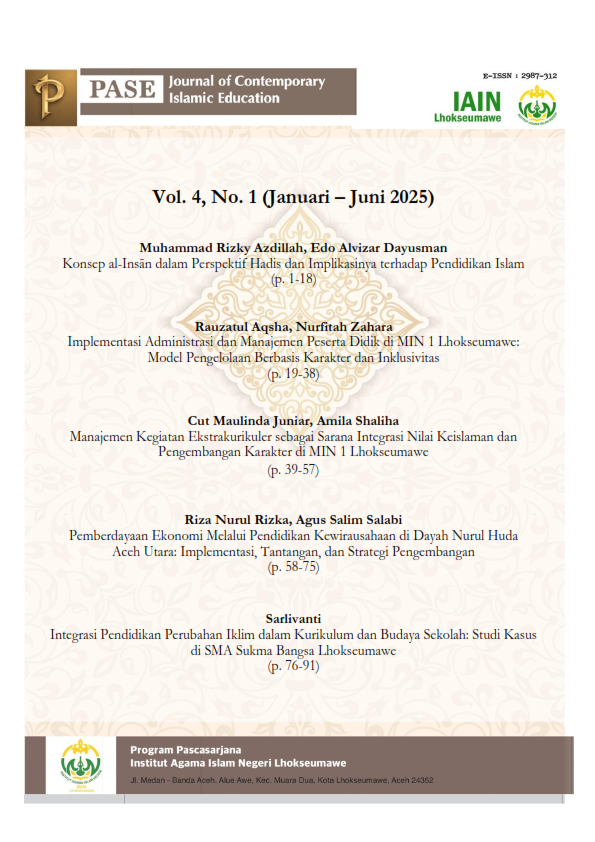
Integrasi Pendidikan Perubahan Iklim dalam Kurikulum dan Budaya Sekolah: Studi Kasus di SMA Sukma Bangsa Lhokseumawe
DOI:
https://doi.org/10.47766/pase.v4i1.5400Keywords:
Climate Change Education, Environmental Literacy, Green School Project, School CultureAbstract
This study aims to analyse the forms and strategies of integrating climate change education into the curriculum and school culture at SMA Sukma Bangsa Lhokseumawe, as well as to assess its impact on students’ environmental literacy and character development. The research employed a qualitative approach with a case study design, focusing on an in-depth understanding of the practices of integrating climate change education within the school setting. Data was collected through in-depth interviews with the principal and teachers, classroom observations, document analysis of school policies and teaching modules, and questionnaires distributed to students. Data analysis followed the Miles and Huberman model, which includes data reduction, data display, and conclusion drawing, while validation was ensured through source and method triangulation. The findings reveal that the integration of climate change education at SMA Sukma Bangsa Lhokseumawe is systematically implemented through project-based interdisciplinary learning, the strengthening of an environmentally friendly school culture, and teacher capacity enhancement through global collaboration. The Green School Project (GSP) serves as a key catalyst in fostering students’ ecological awareness and sustainable behavior. This study concludes that synergy among curriculum, school culture, and instructional leadership is the critical factor driving the success of the climate change education model. The study recommends the development of adaptive curriculum guidelines tailored to local environmental issues and teacher training programs focused on sustainability pedagogy to enhance the implementation of climate-conscious education in schools.
References
Adela, D., & Permana, D. (2020). Integrasi Pendidikan Lingkungan Melalui Pendekatan Ecopedagogy dalam Pembelajaran IPS di Sekolah Dasar. Jurnal BELAINDIKA (Pembelajaran Dan Inovasi Pendidikan), 2(2), 17-26. https://doi.org/10.52005/belaindika.v2i2.41.
Beane, J. A. (1997). Curriculum Integration: Designing the Core of Democratic Education. Teachers College Press.
Bosnjak, M., Ajzen, I., & Schmidt, P. (2020). The theory of planned behavior: Selected recent advances and applications. Europe's journal of psychology, 16(3), 352. https://doi.org/10.1002/9781119568124.ch1.
Brown C, White R, Kelly A (2023), "Teachers as educational change agents: what do we currently know? Findings from a systematic review". Emerald Open Research, Vol. 1 No. 3 pp. No Pagination Specified, doi: https://doi.org/10.1108/EOR-03-2023-0012.
Hadjichambis, A.C., Hadjichambi, D. (2022). Education for Environmental Citizenship Pedagogical Approach: Innovative Teaching and Learning for a Sustainable Future. In: Hsu, YS., Tytler, R., White, P.J. (eds) Innovative Approaches to Socioscientific Issues and Sustainability Education. Learning Sciences for Higher Education. Springer, Singapore. https://doi.org/10.1007/978-981-19-1840-7_12.
Hargreaves, A., & Fullan, M. (2015). Professional Capital: Transforming Teaching in Every School. Teachers College Press.
Kemdikbudristek. (2023). Peta Jalan Pendidikan untuk Pembangunan Berkelanjutan. Jakarta: Kementerian Pendidikan, Kebudayaan, Riset, dan Teknologi.
Leithwood, K., Harris, A., & Hopkins, D. (2020). Seven strong claims about successful school leadership revisited. School Leadership & Management, 40(1), 5–22. https://doi.org/10.1080/13632434.2019.1596077.
Miles, M. B., & Huberman, A. M., Saldana, J. (2014). Qualitative Data Analysis: An Expanded Sourcebook. Thousand Oaks, CA: Sage Publications.
Mochizuki, Y., & Bryan, A. (2015). Climate Change Education in the Context of Education for Sustainable Development: Rationale and Principles. Journal of Education for Sustainable Development, 9(1), 4-26. https://doi.org/10.1177/0973408215569109.
Rehman, N., Zhang, W., Mahmood, A. et al. (2023). Fostering Twenty-First-Century Skills Among Primary School Students Through Math Project-Based Learning. Humanit Soc Sci Commun 10, 424 (2023). https://doi.org/10.1057/s41599-023-01914-5.
Ritchhart, R. (2023). Cultures of Thinking in Action: 10 Mindsets to Transform Our Teaching and Students' Learning. John Wiley & Sons.
Salabi, A. S., & Prasetyo, M. A. M. (2022). Organizational Culture of Sukma Bangsa Learning School (Analytical Study of Learning Organization Primordial Value). SUKMA: Jurnal Pendidikan, 6(1), 91–110. https://jurnal.sukmabangsa.sch.id/index.php/sukma/article/view/06105.2022.
Schein, E. H. (2010). Organizational Culture and Leadership (Vol. 2). John Wiley & Sons.
Schlechty, P. C. (2009). Leading for learning: How to transform schools into learning organizations. John Wiley & Sons.
Sterling, S. (2001). Sustainable Education: Re-Visioning Learning and Change. Green Books.
Stevenson, R. B., Brody, M., Dillon, J., & Wals, A. E. J. (2013). International Handbook of Environmental Education. Routledge.
Sugiyono. (2012). Metode Penelitian Kualitatif, Kuantitatif, dan R&D. Bandung: Alfabeta.
Tilbury, D. (2011). Education for Sustainable Development: An Expert Review of Processes and Learning. Paris: UNESCO. https://unesdoc.unesco.org/ark:/48223/pf0000191442.
UNESCO. (2019). Education for Climate Action: Empowering Learners for Sustainable Development. Paris: UNESCO.
UNESCO. (2021). Getting Every School Climate-Ready: How Countries Are Integrating Climate Change Issues into Education. Paris: UNESCO.
Yin, R. K. (2014). Case Study Research: Design and Methods. Sage Publications.
Downloads
Published
Issue
Section
License
Copyright (c) 2025 Sarlivanti

This work is licensed under a Creative Commons Attribution-ShareAlike 4.0 International License.