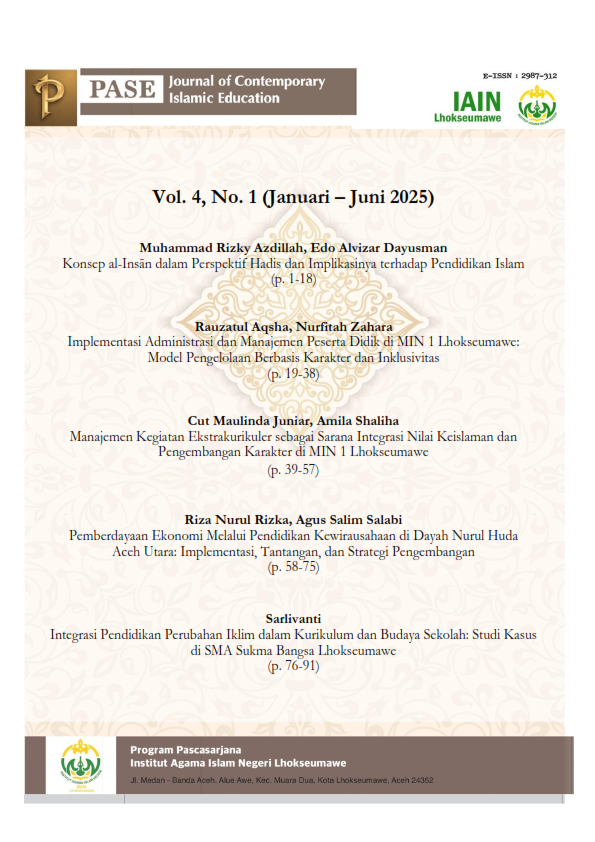
Pemberdayaan Ekonomi Melalui Pendidikan Kewirausahaan di Dayah Nurul Huda Aceh Utara: Implementasi, Tantangan, dan Strategi Pengembangan
DOI:
https://doi.org/10.47766/pase.v3i2.1227Keywords:
Economic Empowerment, Pesantren Entrepreneurship, Spiritual EntrepreneurshipAbstract
This study aims to analyse the model of economic empowerment through the entrepreneurship program at Dayah Nurul Huda, as well as to examine its challenges, supporting factors, and development strategies within the context of modern Islamic boarding school education. The research employed a qualitative descriptive approach with a case study design, using in-depth interviews, participatory observation, and document analysis. Data were analysed thematically to identify patterns of meaning emerging from entrepreneurial practices within the dayah. The findings reveal that the entrepreneurship program at Dayah Nurul Huda integrates Islamic values such as ikhtiar (effort), amanah (trustworthiness), and barakah (divine blessing) with modern management principles based on competence and collaboration. This model gives rise to the concept of “spirituality-based entrepreneurship”, which harmonizes economic orientation with the cultivation of religious character. The main challenges identified include limited financial resources, insufficient entrepreneurship training for teachers (ustaz), and traditional management practices. Meanwhile, significant support stems from collaboration among the dayah, local government, universities, and micro, small, and medium enterprises (MSMEs), which collectively expand business networks and strengthen institutional capacity. These findings are expected to serve as a reference for enhancing the economic self-reliance of Islamic boarding schools and for developing an Islamic entrepreneurship curriculum that remains relevant to contemporary challenges.
References
Adawiyah, S. R. (2018). Pendidikan Kewirausahaan di Pondok Pesantren Sirojul Huda. Comm-Edu (Community Education Journal), 1(2), 81–87. https://doi.org/doi.org/10.22460/comm-edu.v1i2.661.
Al-Attas, S. M. N. (1999). The Concept of Education in Islam: A Framework for an Islamic Philosophy of Education. Kuala Lumpur: ISTAC.
Andayani, F. (2021). Meningkatkan Kinerja Guru Produk Kreatif dan Kewirausahaan Melalui Program Sekolah Pencetak Wirausaha. MANAJERIAL: Jurnal Inovasi Manajemen Dan Supervisi Pendidikan, 1(2), 175–181. https://doi.org/10.51878/manajerial.v1i2.647.
Arikunto, S. (2019). Prosedur Penelitian: Suatu Pendekatan Praktik (Revisi ke-6). Jakarta: Rineka Cipta.
Braun, V., & Clarke, V. (2006). Using Thematic Analysis in Psychology. Qualitative Research in Psychology, 3(2), 77–101. https://doi.org/10.1191/1478088706qp063oa
Bustomi, I., & Umam, K. (2017). Strategi Pemberdayaan Ekonomi Santri dan Masyarakat di Lingkungan Pondok Pesantren Wirausaha Lantabur Kota Cirebon. Al-Mustashfa: Jurnal Penelitian Hukum Ekonomi Syariah, 2(1), 79–90. https://badge.dimensions.ai/details/doi/10.24235/jm.v2i1.1625?domain.
Creswell, J. W., & Poth, C. N. (2018). Qualitative Inquiry and Research Design: Choosing Among Five Approaches (4th ed.). Thousand Oaks, CA: SAGE Publications.
Etzkowitz, H., & Leydesdorff, L. (2000). The Dynamics of Innovation: From National Systems and “Mode 2” To A Triple Helix of University–Industry–Government Relations. Research policy, 29(2), 109-123. https://doi.org/10.1016/S0048-7333(99)00055-4.
Grindle, M. S. (1997). Divergent Cultures? When Public Organizations Perform Well in Developing Countries. World development, 25(4), 481-495. https://doi.org/10.1016/S0305-750X(96)00123-4.
Hasibuan, M. S. P. (2019). Manajemen: Dasar, Pengertian, dan Masalah. Jakarta: Bumi Aksara.
Hawari, F. I., & Fadhillah, N. (2023). Mengintegrasikan Nilai-nilai Agama Islam dalam Praktik Manajemen Perusahaan. Religion: Jurnal Agama, Sosial, Dan Budaya, 2(5), 919-928. https://maryamsejahtera.com/index.php/Religion/article/view/449.
Khaldun, I. (2014). The Muqaddimah: An introduction to history. The Anthropology of Climate Change: An Historical Reader, 55-66. https://doi.org/10.1002/9781394260881.ch3.
Indra, H. (2019). Pesantren and Entrepreneurship Education. Edukasi, 17(2), 294431. https://doi.org/10.32729/edukasi.v17i2.600.
Ismaiyah, N., Suyadi, S., Nadlifah, N., Putro, K. Z., & Astuti, R. (2022). Edupreneurship in Stimulating the Independence of Early Childhood. Golden Age: Jurnal Ilmiah Tumbuh Kembang Anak Usia Dini, 7(3), 143–150. https://doi.org/10.14421/jga.2022.73-04.
Kemendikbud. (2022). Buku Panduan Wirausaha Merdeka. In Direktorat Belmawa Ditjen Dikti (Issue Mi). https://lldikti6.kemdikbud.go.id/wpcontent/uploads/2022/06/Buku-Panduan-Program-WMK.pdf.
Khasanah, D., & Prasetyo, D. D. (2023). Manajemen Kesiswaan dalam Upaya Meningkatkan Prestasi Akademik dan Non-Akademik Peserta Didik. Al-Fahim: Jurnal Manajemen Pendidikan Islam, 5(1), 155-172. https://doi.org/10.54396/alfahim.v5i1.484.
Lubis, H., Aulia, T. Y., & Salabi, A. S. (2022). Strategi Optimalisasi Karyawati dalam Peningkatan Unit Usaha Pesantren Darularafah Raya Deli Serdang. Saree: Research in Gender Studies, 4(2), 68–79. https://doi.org/10.47766/saree.v4i2.1029.
Machali, I. (2018). Managing Quality of Learning in Islamic Schools: An Analysis of Contributing Factors for Learning Toward Quality Improvement in Private Islamic Senior High Schools in Yogyakarta. Jurnal Pendidikan Islam, 7(2), 317-335. https://doi.org/10.14421/jpi.2018.72.317-335.
Mansir, F. (2020). Manajemen Pondok Pesantren di Indonesia dalam Perspektif Pendidikan Islam Era Modern. QALAMUNA: Jurnal Pendidikan, Sosial, Dan Agama, 12(2), 207-216. https://doi.org/10.37680/qalamuna.v12i2.644.
Miles, M. B., Huberman, A. M., & Saldaña, J. (2014). Qualitative Data Analysis: A Methods Sourcebook (3rd ed.). Thousand Oaks, CA: SAGE Publications.
Moleong, L. J. (2017). Metodologi Penelitian Kualitatif (Edisi revisi). Bandung: Remaja Rosdakarya.
Mujahidin, E., & Taman, M. (2005). Pesantren Kilat: Alternatif Pendidikan Agama Di Luar Sekolah. Pustaka Al-Kautsar.
Opti, S., & Rachmawati, N. A. (2022). Transformasi Pembelajaran Menuju Merdeka Belajar Kampus Merdeka: Ditinjau dari Persepsi Peminatan Mahasiswa dan Manfaat Program MBKM. Jurnal Pendidikan (Teori Dan Praktik), 7(1), 45–49. https://doi.org/10.26740/jp.v7n1.p45-49.
Purwanto, M. R., & Supriadi, R. (2019). The Use of Entrepreneurship Education in Community Empowerment at Lintangsongo Islamic Boarding School of Yogyakarta. International Journal of Engineering and Advanced Technology, 9(2), 796-800. https://www.ijeat.org/wp-content/uploads/papers/v9i2/B3740129219.pdf.
Ramli, M. (2018). Karakteristik Pendidikan Pesantren: Sebuah Potret. Al-Falah: Jurnal Ilmiah Keislaman dan Kemasyarakatan, 18(1), 89–116. https://doi.org/10.47732/alfalahjikk.v18i1.56.
Ridwan, M., & Restu, Y. M. (2023). Dinamika Pendidikan Islam: Antara Kearifan Tradisi, Perubahan Transisi, dan Transformasi Modernisasi. HASBUNA: Jurnal Pendidikan Islam, 3(1), 337-350. https://doi.org/10.70143/hasbuna.v3i1.207.
Sa’diyah, H. (2020). Pembangunan Santripreneur Melalui Penguatan Kurikulum Pesantren Berbasis Kearifan Lokal di Era Disruptif. Risâlah, Jurnal Pendidikan Dan Studi Islam, 6(1), 80–99. https://doi.org/doi.org/10.31943/jurnal_risalah.v6i1,%20March.130.
Satori, D., & Komariah, A. (2009). Metodologi Penelitian Kualitatif. Bandung: Alfabeta.
Scarborough, N. M., & Zimmerer, T. W. (1996). Effective Small Business Management (Vol. 2). Upper Saddle River, NJ: Prentice Hall.
Sugiyono. (2009). Metode Penelitian Pendidikan: Pendekatan Kuantitatif, Kualitatif, dan R&D. Bandung: Alfabeta.
Thayyibi, M. I., & Subiyantoro, S. (2022). Konsep Edupreuneurship dan Urgensinya Bagi Lulusan Perguruan Tinggi. Jurnal Eduscience, 9(1), 77–91. https://doi.org/10.36987/jes.v9i1.2538.
Yaqutunnafis, L., & Nurmiati, N. (2021). Manajemen Pondok Pesantren dalam Meningkatkan Pendidikan Kewirausahaan Siswa. Jurnal Ilmu Manajemen, 10(2), 143–154. https://doi.org/doi.org/10.32502/jimn.v10i2.2884.
Yati, R. (2024). Strategi Pengembangan Life Skill Santri Dayah Madrasah Ulumul Qur’an Nagan Raya (Doctoral dissertation, UIN Ar-raniry).
Yin, R. K. (2018). Case Study Research and Applications (6th ed.). Thousand Oaks, CA: Sage Publications.
Downloads
Published
Issue
Section
License
Copyright (c) 2025 Riza Nurul Rizka, Agus Salim Salabi

This work is licensed under a Creative Commons Attribution-ShareAlike 4.0 International License.