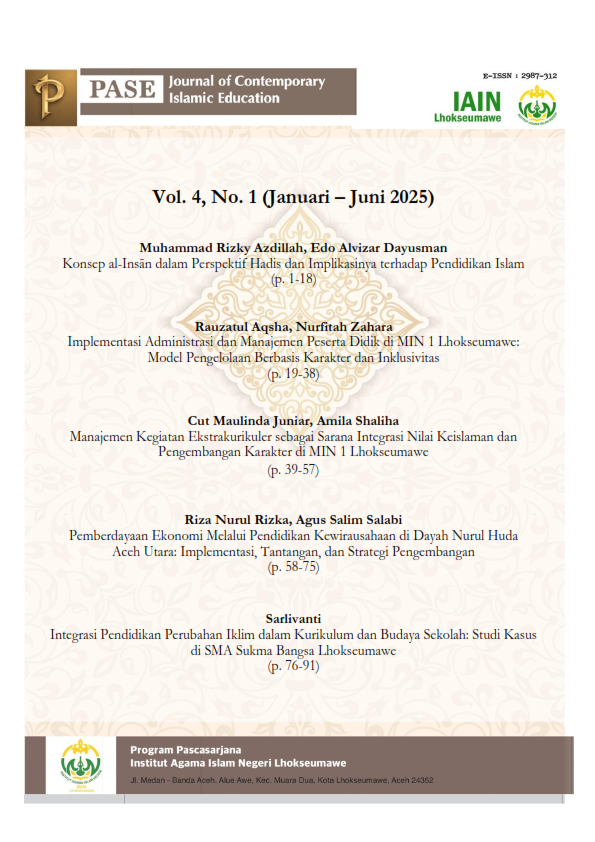
Konsep al-Insān dalam Perspektif Hadis dan Implikasinya terhadap Pendidikan Islam
Keywords:
Concept of al-Insān, Islamic Education, Prophetic HadithAbstract
One of the key terms used in the Qur’an and Hadith to describe human beings is al-Insān, which reflects the spiritual, intellectual, and moral potential that can be developed through education. This study aims to explore in depth the meaning and characteristics of al-Insān as portrayed in the Hadith of Prophet Muhammad (peace be upon him), and to examine its implications for curriculum design and learning strategies in Islamic education. The research employs a qualitative approach using the library research method. Primary data were obtained from Hadiths relevant to the concept of humanity and education, while secondary data were drawn from scholarly literature discussing Islamic educational philosophy, prophetic values, and theories of human potential development. The analysis was conducted through descriptive, textual, and reflective approaches to interpret the meaning and educational relevance of al-Insān. The findings reveal that al-Insān in Hadith is depicted as a being endowed with intellect, soul, heart, and moral responsibility, functioning both as a servant of God and a steward on earth. Prophetic values such as honesty, commitment, and compassion form the core of character development in learners. The concept of al-Insān al-Kāmil—the perfected human—emerges as the ultimate goal of Islamic education, necessitating a value-based curriculum and balanced learning strategies that foster both spiritual and intellectual dimensions. Thus, the concept of al-Insān in the Hadith provides a strong conceptual foundation for Islamic education, aiming to cultivate individuals who are faithful, knowledgeable, and morally upright.
References
Al-Attas, S. M. N. (1999). The Concept of Education in Islam: A Framework for an Islamic Philosophy of Education. Kuala Lumpur: ISTAC.
al-Ṭabarānī, S. ibn A. (n.d.). al-Mu‘jam al-Kabīr. Cairo: Maktabah Ibn Taymiyyah.
Amnur, A. M. (2007). Metodologi Penelitian Pendidikan Islam. Jakarta: PT RajaGrafindo Persada.
Bloom, B. S. (1956). Taxonomy of Educational Objectives: The Classification of Educational Goals. Handbook I: Cognitive Domain. New York: David McKay Company.
Bungin, B. (2011). Metodologi Penelitian Kualitatif: Aktualisasi Metodologis ke Arah Ragam Varian Kontemporer. Jakarta: Rajawali Pers.
Dayusman, E. A., & Nazaruddin, N. (2025). Paradigma Pendidikan Islam Kontemporer: Reinterpretasi Tujuan, Kurikulum, dan Relevansi Sosial. AHDÃF: Jurnal Pendidikan Agama Islam, 3(1), 1-10. https://doi.org/10.47766/ahdf.v3i1.5044.
Gardner, H. (2006). Multiple Intelligences: New Horizons in Theory and Practice. New York: Basic Books.
Goleman, D. (1995). Emotional Intelligence: Why It Can Matter More Than IQ. New York: Bantam Books.
Haryono, A. (2023). Filsafat Pendidikan Islam: Konsep, Teori, dan Praktik. Yogyakarta: Deepublish.
Ibnu Majah. Sunan Ibnu Majah. (Hadis tentang Kewajiban Menuntut Ilmu).
Kristi, E., Alwizar, A., & Yusuf, K. (2022). Hakikat Manusia dalam Perspektif Al-Qur’an. Risâlah Jurnal Pendidikan dan Studi Islam, 8(1), 115-129. https://doi.org/10.31943/jurnal_risalah.v8i1.217.
Lickona, T. (2013). Character Education: The Cultivation of Virtue." In Instructional-design Theories and Models, pp. 591-612. Routledge, 2013.
Maddux, J. E., & Rogers, R. W. (1983). Protection Motivation and Self-Efficacy: A Revised Theory of Fear Appeals and Attitude Change. Journal of Experimental Social Psychology, 19(5), 469-479. https://doi.org/10.1016/0022-1031(83)90023-9.
Mardiati, A., Ahmad, N., & Suhartini, A. (2021). Konsep Peran dan Tanggung Jawab Manusia dalam Kehidupan di Dunia dan Implikasinya terhadap Pendidikan Islam. Jurnal Naratas, 3(1), 50-54. https://journal.stai-musaddadiyah.ac.id/index.php/JN/article/view/44.
Moleong, L. J. (2017). Metodologi Penelitian Kualitatif. Bandung: Remaja Rosdakarya.
Muslim. Sahih Muslim. (Hadis tentang Niat, Ilmu, dan Tanggung Jawab).
Noor, A. H. (2024). Paradigma Wahdat Al-Ulum (Konsep Pemikiran Integritas Keilmuan dalam Pandangan Al-Ghazali dan Ibnu Sina serta Relevansinya terhadap Perguruan Tinggi). Halaqah: Journal of Multidisciplinary Islamic Studies, 1(1), 146–165. https://doi.org/10.62509/hjis.v1i1.117.
Nuraida, N., Azis, A., Nasuhi, A., & Lubis, L. H. (2022). Holistic Education for Developing Early Childhood Potential: A Literature Review. Educational Review: International Journal, 19(2), 221-249. https://acasch.com/index.php/er/article/view/38.
Tanjung, M. (2020). Konsep Manusia dalam Perspektif Filsafat Pendidikan Islam. An Nadwah, 25(1), 46. http://dx.doi.org/10.37064/nadwah.v25i1.7480.
Salabi, A. S. (2020). Efektivitas dalam Implementasi Kurikulum Sekolah. Education Achievement: Journal of Science and Research. https://doi.org/10.51178/jsr.v1i1.177.
Sugiyono. (2012). Metode Penelitian Kualitatif, Kuantitatif, dan R&D. Bandung: Alfabeta.
Suryadi, R. A. (2015). Dimensi-Dimensi Manusia: Perspektif Pendidikan Islam. Deepublish.
Syarif, M. (2017). Hakekat Manusia dan Implikasinya pada Pendidikan Islam. Jurnal Pendidikan Agama Islam Al-Thariqah, 2(2), 135–147. https://doi.org/10.25299/althariqah.2017.vol2(2).1042.
Wahib, A. (2021). Integrasi Pendidikan Karakter Berbasis Intelectual, Emotional and Spiritual Quotient dalam Bingkai Pendidikan Islam. TADRIS: Jurnal Pendidikan Islam, 16(2), 479-494. https://doi.org/10.19105/tjpi.v16i2.4758.
Downloads
Published
Issue
Section
License
Copyright (c) 2025 Muhammad Rizky Azdillah, Edo Alvizar Dayusman

This work is licensed under a Creative Commons Attribution-ShareAlike 4.0 International License.