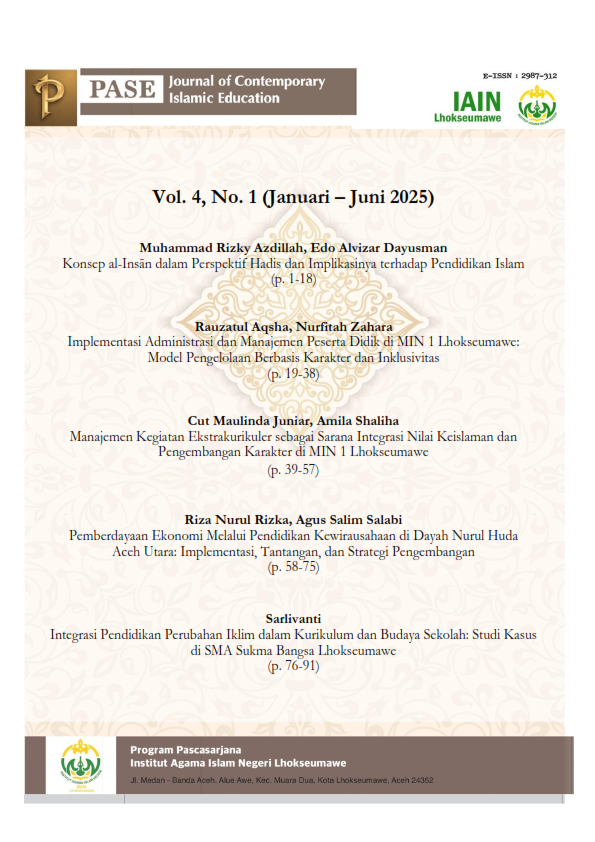
Penguatan Karakter Islami Siswa melalui Kegiatan Ekstrakurikuler di MIN 1 Lhokseumawe
DOI:
https://doi.org/10.47766/pase.v4i1.5214Keywords:
Character Education, Islamic Values, Local Culture, Value IntegrationAbstract
This study is grounded in the importance of strengthening students’ character through the integration of Islamic values and local culture within the madrasah environment. At MIN 1 Kota Lhokseumawe, the synergy between Islamic principles and Acehnese cultural values serves as a strategic foundation for realizing holistic and context-based character education. The research employed a qualitative descriptive approach, with data collected through observation, interviews, and documentation. The research informants consisted of the principal, extracurricular supervisors, and students. Data were analyzed through three main stages: data condensation, data display, and conclusion drawing, with validation conducted through source and method triangulation. The findings indicate that the integration of Islamic values and local culture at MIN 1 Kota Lhokseumawe is implemented through four systematic stages: (1) formulation of school policies emphasizing an Islamic character vision and local wisdom; (2) implementation of instructional and extracurricular activities based on Islamic values; (3) internalization of values through social practices, worship, and cultural activities; and (4) continuous evaluation conducted by teachers and the school administration. The model of integrating Islamic and local cultural values has been proven to strengthen students’ holistic character formation, fostering a balance between ḥablum minallāh (relationship with God) and ḥablum minannās (relationship with others). The study also recommends the development of a digital system for documenting and evaluating character-building activities to enhance the effectiveness and sustainability of Islamic values implementation in madrasah education.
References
Amelia, R., Khusna, Z. M., Fadilah, S. N., & Rif’iyati, D. (2024). Pembelajaran Seni Musik Islami untuk Pembentukan Pendidikan Karakter di Sekolah Dasar. Wildan: Jurnal Pendidikan dan Pengajaran-STAI Bani Saleh, 3(2), 85-90. https://doi.org/10.54125/wildan.v3i2.32.
Amreta, M. Y. (2018). Pengaruh Kegiatan Pramuka terhadap Karakter Siswa Madrasah Ibtidaiyah di Era Digital. Al Ulya: Jurnal Pendidikan Islam, 3(1), 26-38. https://core.ac.uk/download/pdf/287204498.pdf.
Bandura, A., & Walters, R. H. (1977). Social Learning Theory (Vol. 1, pp. 141-154). Englewood Cliffs, NJ: Prentice Hall.
Creswell, J. W. (2014). Research Design: Qualitative, Quantitative, and Mixed Methods Approaches (4th ed.). Sage Publications.
Denzin, N. K. (2017). The Research Act: A Theoretical Introduction to Sociological Methods. Routledge. https://doi.org/10.4324/9781315134543.
Greene, K. M., & Maggs, J. L. (2015). Revisiting the Time Trade-Off Hypothesis: Work, Organized Activities, and Academics During College. Journal of Youth and Adolescence, 44(8), 1623-1637. https://doi.org/10.1007/s10964-014-0215-7.
Hapsari, M. M. (2022). Scout Extracurricular Activity: A Positive Effect on Students' Potential Entrepreneurial Character. Jurnal Kependidikan: Penelitian Inovasi Pembelajaran, 6(2), 163-172. https://doi.org/10.21831/jk.v6i2.52415.
Hidayat, S. (2021). Integrasi Nilai Islam dalam Pendidikan: Pembelajaran Integratif di SMA Islam Al-Muttaqin Kota Tasikmalaya. TADRIS: Jurnal Pendidikan Islam, 16(1), 141-156. https://doi.org/10.19105/tjpi.v16i1.4665.
Khabibah, S. (2023). Implementasi Fungsi Manajemen dalam Program Ekstrakurikuler di Madrasah Ibtidaiyah Pesantren Anak Sholeh Baitul Quran. Excelencia: Journal of Islamic Education & Management, 3(01), 13-24. https://doi.org/10.21154/excelencia.v3i01.1544.
Khasanah, D., & Prasetyo, D. D. (2023). Manajemen Kesiswaan dalam Upaya Meningkatkan Prestasi Akademik dan Non-Akademik Peserta Didik. Al-Fahim: Jurnal Manajemen Pendidikan Islam, 5(1), 155-172. https://doi.org/10.54396/alfahim.v5i1.484.
Kosim, M. (2020). Penguatan Pendidikan Karakter di Era Industri 4.0: Optimalisasi Pendidikan Agama Islam di Sekolah. TADRIS: Jurnal Pendidikan Islam, 15(1), 88-107. https://doi.org/10.19105/tjpi.v15i1.2416.
Kulon, M. (2024). Pembentukan Karakter Siswa Melalui Program Ekstrakurikuler di Madrasah Ibtidaiyaih Sunan Ampel II. Elementary: Journal of Primary Education, 2(1), 8-11. https://doi.org/10.55210/elementary.v2i1.371.
Lerner, R. M., Lerner, J. V., Almerigi, J. B., Theokas, C., Phelps, E., Gestsdottir, S., ... & von Eye, A. (2005). Positive Youth Development, Participation in Community Youth Development Programs, and Community Contributions of Fifth-Grade Adolescents: Findings from the First Wave of the 4-H Study of Positive Youth Development. The journal of early adolescence, 25(1), 17-71. https://doi.org/10.1177/0272431604272461.
Lickona, T. (2013). Character Education: The Cultivation of Virtue. In Instructional-Design Theories and Models (pp. 591-612). Routledge.
Miles, M. B., Huberman, A. M., & Saldaña, J. (2014). Qualitative Data Analysis: A Methods Sourcebook (3rd ed.). Sage Publications.
Moleong, L. J. (2017). Metodologi Penelitian Kualitatif (Revisi ed.). Remaja Rosdakarya.
Noho, M., Sebe, K. M., Andy, A., Juliadarma, M., Rumalean, S., & Osamalu, N. (2022). Manajemen Pengembangan Bakat dan Minat Peserta Didik di Madrasah Aliyah Negeri 1 Tidore. Intelektual: Jurnal Pendidikan dan Studi Keislaman, 12(2), 141-156. https://doi.org/10.33367/ji.v12i2.2793.
Putri, D. A. P., & Usriyah, L. (2019). Pengembangan Kecerdasan Kinestetik Peserta Didik Melalui Kegiatan Ekstrakurikuler Tari Tradisional di Madrasah Ibtidaiyah Unggulan Al-Islah Kecamatan Muncar Kabupaten Banyuwangi. EDUCARE: Journal of Primary Education, 1(1), 1-16. https://doi.org/10.35719/educare.v1i1.2.
Salabi, A. S., & Prasetyo, M. A. M. (2022). The Internalization of Banjaran Cultural Character Values in Mustafawiyah Islamic Boarding School, Purbabaru. MIQOT: Jurnal Ilmu-Ilmu Keislaman, 46(2), 257-273. http://dx.doi.org/10.30821/miqot.v46i2.900.
Schaefer, D. R., Simpkins, S. D., Vest, A. E., & Price, C. D. (2011). The Contribution of Extracurricular Activities to Adolescent Friendships: New Insights Through Social Network Analysis. Developmental psychology, 47(4), 1141. https://psycnet.apa.org/doi/10.1037/a0024091.
Sugiyono. (2018). Metode Penelitian Pendidikan: Pendekatan Kuantitatif, Kualitatif, dan R&D. Alfabeta.
Wang, W., Li, W., & Yao, J. (2024). The Relationship Between Participation in Extracurricular Arts and Sports Activities and Adolescents’ Social and Emotional Skills: An Empirical Analysis Based on the OECD Social and Emotional Skills Survey. Behavioral Sciences, 14(7), 541. https://doi.org/10.3390/bs14070541.
Widyawati, E. R., & Sukadari, S. (2023). Pemanfaatan Media Pembelajaran Berbasis Teknologi sebagai Alat Pembelajaran Kekinian bagi Guru Profesional IPS dalam Penerapan Pendidikan Karakter Menyongsong Era Society 5.0. Proceedings Series on Social Sciences & Humanities, 10, 215-225. https://conferenceproceedings.ump.ac.id/pssh/article/view/667/708.
Yulianti, H. (2023). Implementasi Layanan Ekstrakurikuler Pramuka dalam Pembentukan Karakter Peserta Didik di Madrasah Ibtidaiyah Negeri 3 Jember. Mataazir: Jurnal Administrasi dan Manajemen Pendidikan, 5(1). 151-161. https://core.ac.uk/download/pdf/618335443.pdf.
Zulfikar, Z., Al Husaini, M. D., & Salabi, A. S. (2024). Integrasi Nilai-nilai Kearifan Lokal dalam Manajemen Pendidikan Pesantren: Studi pada Dayah Raudhatul Ma’arif Al-Aziziyah Cot Trueng. ITQAN: Jurnal Ilmu-ilmu Kependidikan, 15(1), 53-64. https://doi.org/10.47766/itqan.v15i1.2465.
Downloads
Published
Issue
Section
License
Copyright (c) 2025 Cut Maulinda Juniar, Amila Shaliha

This work is licensed under a Creative Commons Attribution-ShareAlike 4.0 International License.