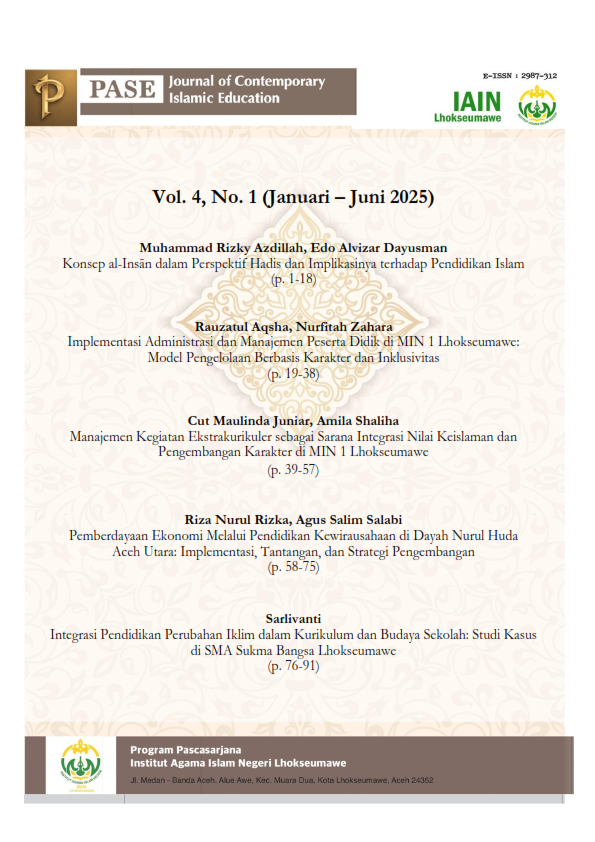
Implementasi Administrasi dan Manajemen Peserta Didik di MIN 1 Lhokseumawe: Model Pengelolaan Berbasis Karakter dan Inklusivitas
Keywords:
Educational Administration, Management Model, Student ManagementAbstract
This study examines the implementation of student administration and management at MIN 1 Lhokseumawe, aiming to formulate a character-based and inclusive management model within Islamic education. Administration operates at the policy and strategic planning level, including the formulation of regulations, record-keeping, and oversight of student-related policies. Meanwhile, management focuses on operational implementation, such as student admission (PPDB), character development, counseling services, and personal growth activities. This research employed a qualitative approach with a case study design, using interviews, observations, and document analysis. Data were analyzed following the Miles et al. model through data condensation, display, and conclusion drawing, with triangulation of sources and methods to ensure validity. The findings reveal that the integration of administration and management at the madrasah is realized using the EMIS system, regular evaluative meetings, and collaborative leadership between teachers and school administrators. The application of Islamic values such as syūrā (consultation), amānah (trustworthiness), and iḥsān (excellence) serves as the moral foundation of the entire management process. The resulting model can be categorized as collaborative and data-driven management, integrating administrative policy direction with adaptive and reflective managerial practices. This synergy creates an accountable, participatory, and character-oriented student management system aligned with the spirit of modern Islamic education.
References
Abdussamad, Z. (2022). Buku Metode Penelitian Kualitatif. https://doi.org/10.31219/osf.io/juwxn.
Apriyani, D., Abubakar, A., & Waluyo, K. E. (2024). Manajemen Peserta Didik dalam Rangka Pelayanan Pembelajaran Kepada Peserta Didik di SMAN 1 Telagasari. Indonesian Research Journal on Education, 4(2). https://doi.org/10.31004/irje.v4i2.503.
Arbain, M. A., Rizqa, M., Irma, A., & Amalia Putri, N. (2024). Tantangan dan Peluang Teknologi Informasi dalam Meningkatkan Efisiensi Administrasi Pendidikan. PANDU : Jurnal Pendidikan Anak Dan Pendidikan Umum, 2(2), 22–27. https://doi.org/10.59966/pandu.v2i2.933.
Badruttamam, B., Abdullah, A., & Aini, N. (2023). Manajemen Peserta Didik dalam Meningkatkan Prestasi Akademik dan Non Akademik Siswa di SMAS Puteri At-Tanwir Sampang. AL -ALLAM, 6(1), 31–43. https://doi.org/10.35127/jurnalpendidikan.v6i1.7907.
Black, P., & Wiliam, D. (2018). Classroom Assessment and Pedagogy. Assessment in Education: Principles, Policy & Practice, 25(6), 551–575. https://doi.org/10.1080/0969594X.2018.1441807.
Bush, T. (2020). Theories of Educational Leadership and Management.
Creswell, J. W., & Creswell, J. D. (2017). Research Design: Qualitative, Quantitative, and Mixed Methods Approaches. Sage Publications.
Dalilah, D. D., Utami, N., & Syauqiyyah, Y. A. (2023). Pola Komunikasi Guru dan Orang Tua untuk Meningkatkan Kualitas Belajar Peserta Didik. NUSRA: Jurnal Penelitian Dan Ilmu Pendidikan, 4(3), 349–362. https://doi.org/10.55681/nusra.v4i3.1021.
Daniel, M. (2022). Strategi Manajemen Kesiswaan dalam Penjurusan Siswa. TAUJIH: Jurnal Pendidikan Islam, 4(2), 74–87. https://doi.org/10.53649/taujih.v4i2.159.
Diana & Azdillah. (2024). Implementasi Manajemen Kesiswaan dalam Mendukung Peningkatan Prestasi Belajar Siswa di MAN 4 Aceh Selatan. Pase: Journal of Contemporary Islamic Education, 3(2). 161-176. https://doi.org/10.47766/pase.v3i2.5220.
Durlak, J. A. (2020). Programme Implementation in Social and Emotional Learning: Basic Issues and Research Findings. In Social and Emotional Learning (pp. 60–72). Routledge.
Eviyana, E., Diana, N., Kholid, I., & Masykur, R. (2021). Participatory Management in Improving the Quality of Madrasah. Edukasi Islami: Jurnal Pendidikan Islam, 9(02), 637. https://doi.org/10.30868/ei.v9i02.1285.
Grigorieva, M. V., Shamionov, R. M., Grinina, E. S., Sozonnik, A. V., & Krasnova, S. V. (2021). Component Structure of Academic Adaptation at Primary School Age. Perspectives of Science and Education, 52(4), 247–262. https://doi.org/10.32744/pse.2021.4.16.
Hargreaves, A., & Fullan, M. (2020). Professional Capital After the Pandemic: Revisiting and Revising Classic Understandings of Teachers’ Work. Journal of Professional Capital and Community, 5(3/4), 327–336. https://doi.org/10.1108/JPCC-06-2020-0039.
Harris, A., & Spillane, J. (2008). Distributed Leadership Through the Looking Glass. Management in Education, 22(1), 31–34. https://doi.org/10.1177/0892020607085623.
Rahmadani, A., Tanjung, R. R., & Melisa, W. (2024). Konsep Administrasi Pendidikan. Dewantara: Jurnal Pendidikan Sosial Humaniora, 3(3), 79-86. https://doi.org/10.30640/dewantara.v3i3.2848.
Hoy, W. K., & Miskel, C. G. (2013). Educational Administration: Theory, Research, and Practice (9th ed.). New York: McGraw-Hill.
Jamaludin, U., Reksa Adya Reksa, & Fina Darma Aisahini. (2023). Pengelolaan Manajemen Peserta Didik dalam Meningkatkan Karakter Siswa. Didaktik : Jurnal Ilmiah PGSD STKIP Subang, 9(2), 4631–4639. https://doi.org/10.36989/didaktik.v9i2.1052.
Kusmawan, A. (2022). Implementasi Manajemen Kesiswaan Sebagai Upaya Penanaman Karakter Siswa. IEMJ: Islamic Education Management Journal, 1(1), 11-19. https://journal.almaarif.ac.id/index.php/iemj/article/view/82.
Komara, E. (2018). Penguatan Pendidikan Karakter dan Pembelajaran Abad 21. SIPATAHOENAN: South-East Asian Journal for Youth, Sports & Health Education, 4(1), 17–26.
Makkaraka, A. M. R. B., Akbar Iskandar, & Wang Yang. (2024). Design of Web-Based Student Academic Information System. Ceddi Journal of Education, 3(2), 9–15. https://doi.org/10.56134/cje.v3i2.102.
Miles, M. B., & Huberman, A. M., Saldana, J. (2014). Qualitative Data Analysis: An Expanded Sourcebook. Thousand Oaks, CA: Sage Publications.
Min, G., Lin, M., Liu, Y., Yang, N., & Li, Z. (2023). Research on the Evaluation Model of School Management Quality in the Compulsory Education Stage Based on Big Data Technology. Sustainability, 15(13), 9987. https://doi.org/10.3390/su15139987.
Moleong, L. J. (2017). Metodologi Penelitian Kualitatif. Bandung: Remaja Rosdakarya.
Mubin, F. (2020). Analisis Posisi Sistem Pendidikan. https://doi.org/10.31219/osf.io/s73ew.
Mulyasa, H. E. (2022). Manajemen dan Kepemimpinan Kepala Sekolah. Bumi Aksara.
Owens, R. G., & Valesky, T. C. (2021). Organizational Behavior in Education: Leadership and School Reform (12th ed.). New York: Pearson.
Sugiyono. (2012). Metode Penelitian Kualitatif, Kuantitatif, dan R&D. Bandung: Alfabeta.
Sujarwo, A. (2024). Implementasi Manajemen Pendidikan Islam Berbasis Karakter: Strategi Pembangunan Karakter Siswa di Madrasah. EDUKASIA Jurnal Pendidikan dan Pembelajaran, 5(1), 2059-2070. https://doi.org/10.62775/edukasia.v5i1.1174.
Fadhli, M. (2017). Manajemen Peningkatan Mutu Pendidikan. Tadbir : Jurnal Studi Manajemen Pendidikan, 1(2), 215–240. https://doi.org/10.29240/jsmp.v1i2.295.
Rahmah, A. M. (2023). Manajemen Kepala Sekolah dalam Upaya Meningkatkan Mutu Sekolah di SMP Plus Ma’arif NU Pangandaran. Sosiosaintika, 1(1), 14–22. https://doi.org/10.59996/sosiosaintika.v1i1.31.
Robbins, S. P. (1996). Perilaku Organisasi (edisi ke 7). Prehallindo.
Sagala, S. (2013). Manajemen Strategik dalam Peningkatan Mutu Pendidikan. Bandung: Alfabeta.
Sassi, K. (2018). Ta’Dib As a Concept of Islamic Education Purification: Study on the Thoughts of Syed Muhammad Naquib Al-Attas. Journal of Malay Islamic Studies, 2(1), 1–14. https://doi.org/10.19109/jmis.v2i1.2541.
UNESCO. (2020). Inclusive Education: From Policy to Practice. Paris: UNESCO Publishing.
Stufflebeam, D. L., & Zhang, G. (2017). The CIPP Evaluation Model: How to Evaluate for Improvement and Accountability. Guilford Publications.
Taqwa, T. (2016). Pendekatan Manajemen Peserta Didik. Kelola: Journal of Islamic Education Management, 1(1), 48–55. https://doi.org/10.24256/kelola.v1i1.428.
Wasehudin, W., Anshori, I., Rahman, M. T., Syafe’i, I., & Kesuma, G. C. (2021). A Creativity Education Model for Coastal Communities Amid the Covid-19 Pandemic. Journal of Environmental Management and Tourism, 12(3), 729–741. https://doi.org/10.14505//jemt.12.3(51).12.
Yusuf, A., Nuraeni, R., & Nur’aeni, N. (2024). Dampak penggunaan Sistem Informasi Manajemen dalam Pengambilan Keputusan SDM. EKOMA : Jurnal Ekonomi, Manajemen, Akuntansi, 4(3). https://doi.org/10.56799/ekoma.v4i3.6480.
Downloads
Published
Issue
Section
License
Copyright (c) 2025 Rauzatul Aqsha, Nurfitah Zahara

This work is licensed under a Creative Commons Attribution-ShareAlike 4.0 International License.