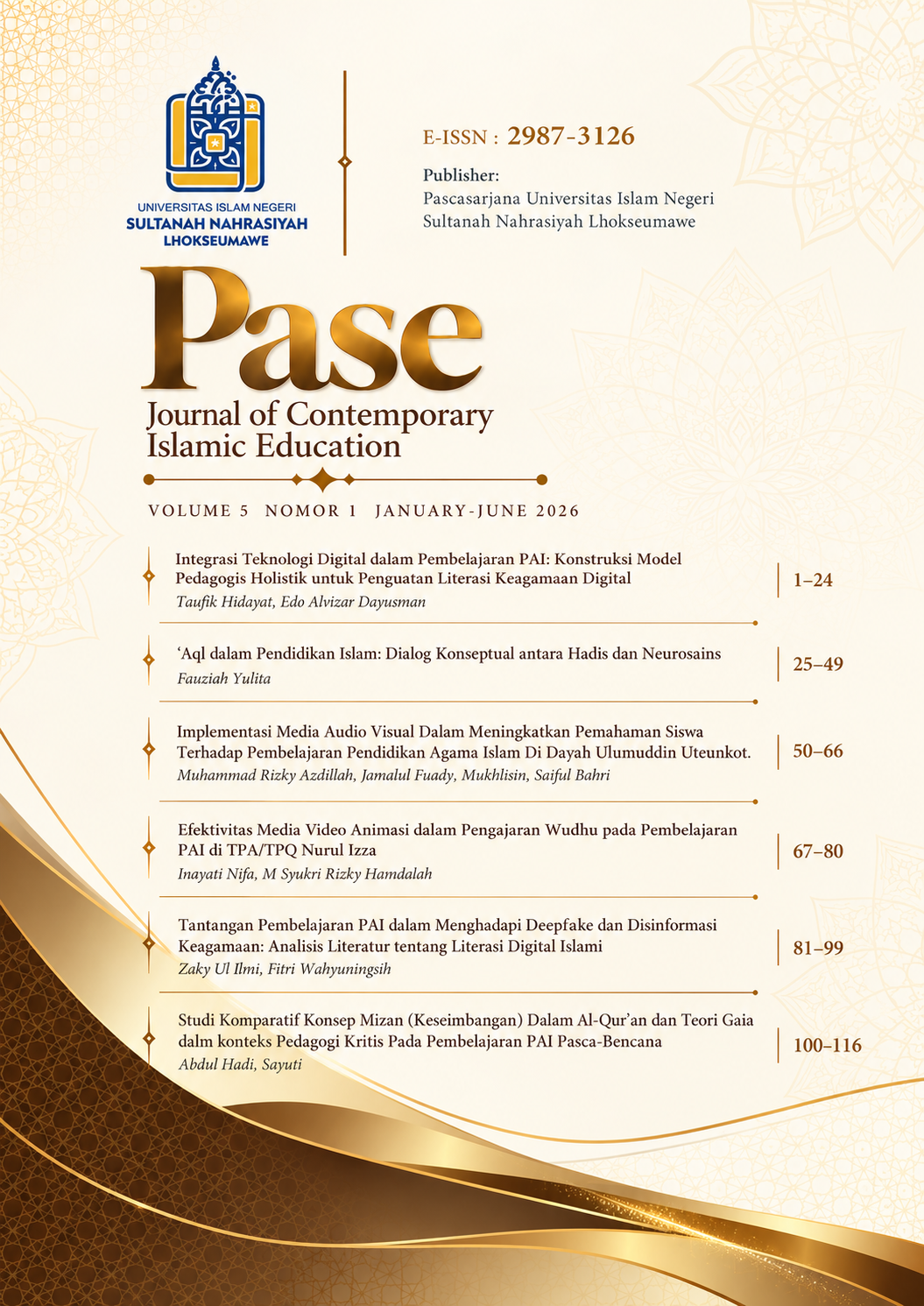
ʿAql dalam Pendidikan Islam: Dialog Konseptual antara Hadis dan Neurosains
DOI:
https://doi.org/10.47766/pase.v5i1.6763Keywords:
ʿAql, Neurosains, Pendidikan IslamAbstract
Penelitian ini bertujuan merekonstruksi fungsi ʿaql berdasarkan hadis Nabi Muhammad saw., memetakan kesepadanan fungsionalnya dengan proses kognitif yang dibahas dalam neurosains, serta menganalisis batas konseptual antara konstruksi normatif Islam dan penjelasan empiris neurosains. Penelitian menggunakan pendekatan integrative literature review dengan analisis tekstual-konseptual dan komparatif. Sumber penelitian mencakup hadis, literatur keislaman, serta publikasi ilmiah mengenai neurosains dan fungsi kognitif. Hasil penelitian menunjukkan bahwa ʿaql dalam perspektif hadis tidak memadai jika dipahami sebagai kecerdasan atau kemampuan intelektual semata, melainkan mencakup kapasitas memahami, menyadari, mempertimbangkan, mengendalikan, dan mengarahkan tindakan menuju pertanggungjawaban moral. Kelima fungsi tersebut memiliki kesepadanan pada tingkat fungsi dengan Working memory, metacognition, cognitive control, inhibitory control, dan self-regulation. Namun, kesepadanan tersebut tidak menunjukkan identitas konseptual maupun neural. Neurosains memberikan penjelasan empiris mengenai proses kognitif yang mendukung berbagai kapasitas tersebut, sedangkan hadis memberikan kerangka normatif mengenai pengetahuan, nilai, dan pertanggungjawaban. Penelitian ini karena itu menawarkan konstruksi ʿaql sebagai konstruk kognitif-normatif yang dapat didialogkan dengan neurosains tanpa mereduksi makna keislamannya menjadi mekanisme neural.
References
Abu Dawud, S. (n.d.). Sunan Abī Dāwūd.
al-Bukhari, M. ibn I. (n.d.). Ṣaḥīḥ al-Bukhārī.
al-Tirmidhi, M. ibn I. (n.d.). Jāmiʿ al-Tirmidhī.
Diamond, A. (2013). Executive functions. Annual Review of Psychology, 64, 135-168. https://doi.org/10.1146/annurev-psych-113011-143750
Dörrenbächer-Ulrich, L., & Bregulla, M. (2024). The relationship between self-regulated learning and executive functions-A systematic review. Educational Psychology Review, 36, 95. https://doi.org/10.1007/s10648-024-09932-8
Immordino-Yang, M. H. (2016). Emotions, learning, and the brain: Exploring the educational implications of affective neuroscience. W. W. Norton & Company.
Izutsu, T. (2002). Ethico-religious concepts in the Qur’an. McGill-Queen’s University Press.
Jailani, M., Suyadi, S., Kholis, N., & Huda, M. (2023). Critical analysis of ʿaql and brain in the paradigm of the Qur’an and neuroscience and its contribution to the development of Islamic education. Taqaddumi: Journal of Quran and Hadith Studies, 3(1). https://doi.org/10.12928/taqaddumi.v3i1.8208
Kasno. (2019). Aql dan otak dalam kajian neurosains dan implikasinya pendekatan saintifik dalam pendidikan Islam. Muaddib: Studi Kependidikan dan Keislaman, 1(2), 154-177. https://doi.org/10.24269/muaddib.v1i2.2217
Nasr, S. H. (2012). The heart of Islam: Enduring values for humanity. HarperOne.
NurJannah, N., & Suyadi, S. (2022). Akal dan qalb dalam perspektif Al Quran dan neurosains. MANAZHIM, 4(1), 53-65. https://doi.org/10.36088/manazhim.v4i1.1617
OECD. (2021). Beyond academic learning: First results from the survey of social and emotional skills. OECD Publishing. https://doi.org/10.1787/92a11084-en
Snyder, H. (2019). Literature review as a research methodology: An overview and guidelines. Journal of Business Research, 104, 333-339. https://doi.org/10.1016/j.jbusres.2019.07.039
Suyadi, S. (2019). Hybridization of Islamic education and neuroscience: Transdisciplinary studies of ʿaql in the Quran and the brain in neuroscience. Dinamika Ilmu, 19(2), 237-249. https://doi.org/10.21093/di.v19i2.1601
Suyadi, S. (2022). Learning taxonomy of Islamic education: The development of aql and the brain in Quran from a neuroscience perspective. Millah: Journal of Religious Studies, 21(2), 361-410. https://doi.org/10.20885/millah.vol21.iss2.art3
Whittemore, R., & Knafl, K. (2005). The integrative review: Updated methodology. Journal of Advanced Nursing, 52(5), 546-553. https://doi.org/10.1111/j.1365-2648.2005.03621.x
Muslim ibn al-Hajjaj. (n.d.). Ṣaḥīḥ Muslim.
Egner, T. (2023). Principles of cognitive control over task focus and task switching. Nature Reviews Psychology, 2, 702-714. https://doi.org/10.1038/s44159-023-00234-4
Katyal, S., & Fleming, S. M. (2024). The future of metacognition research: Balancing construct breadth with measurement rigor. Cortex, 171, 223-234. https://doi.org/10.1016/j.cortex.2023.11.002
Li, S., Rosen, M. C., Chang, S., David, S., & Freedman, D. J. (2023). Alterations of neural activity in the prefrontal cortex associated with deficits in Working memory performance. Frontiers in Behavioral Neuroscience, 17, 1213435. https://doi.org/10.3389/fnbeh.2023.1213435
Menon, V., & D’Esposito, M. (2022). The role of PFC networks in cognitive control and executive function. Neuropsychopharmacology, 47, 90-103. https://doi.org/10.1038/s41386-021-01152-w
Pas, P., Hulshoff Pol, H. E., Raemaekers, M., & Vink, M. (2021). Self-regulation in the pre-adolescent brain. Developmental Cognitive Neuroscience, 51, 101012. https://doi.org/10.1016/j.dcn.2021.101012
Sitaram, R., Sanchez-Corzo, A., Vargas, G., Cortese, A., El-Deredy, W., Jackson, A., & Fetz, E. (2024). Mechanisms of brain self-regulation: Psychological factors, mechanistic models and neural substrates. Philosophical Transactions of the Royal Society B: Biological Sciences, 379(1915), 20230093. https://doi.org/10.1098/rstb.2023.0093
Soleh, K., & Iskandar, A. (2020). Metodologi kritik dan pendekatan dalam memahami hadis. Jurnal Studi Hadis Nusantara, 2(2), 174-193. https://doi.org/10.24235/jshn.v2i2.7651
Wessel, J. R., & Anderson, M. C. (2024). Neural mechanisms of domain-general inhibitory control. Trends in Cognitive Sciences, 28(2), 124-143. https://doi.org/10.1016/j.tics.2023.09.008
Downloads
Published
Issue
Section
License
Copyright (c) 2026 Fauziah Yulita

This work is licensed under a Creative Commons Attribution-ShareAlike 4.0 International License.